
The funnel is not wrong. It is just incomplete. Real buyers do not move in stages. They move in spirals, shortcuts, and leaps. Here is what that means for your SaaS marketing strategy.
The funnel is the most useful lie in marketing.
Useful because it gives you a framework. A visual. A way to talk about the buyer journey in a meeting without everyone losing the plot.
A lie because nobody actually moves through it the way the diagram says they do.
And SaaS marketing has been optimized around the diagram for so long that most teams have forgotten to look at what buyers are actually doing. Many modern SaaS marketing strategies are still designed around this simplified model rather than actual buyer behavior.
The Saas Marketing Funnel is Evolving
Let us be precise here.
TOFU, MOFU, BOFU. Awareness, consideration, decision. The funnel is not a bad idea. It is a useful abstraction. A way to organize thinking, allocate resources, and talk about where buyers are in their relationship with your product.
The problem is that it gets treated as a map when it is actually a legend.
A legend tells you what the symbols mean. It does not tell you the actual terrain. And the terrain of how real B2B buyers actually make decisions is far more chaotic, non-linear, and genuinely strange than the funnel acknowledges, especially in modern B2B SaaS marketing environments where multiple channels and stakeholders shape the decision process.
The flywheel tried to fix this. Made it circular. Added momentum as a concept. Better. Still incomplete.
Because the real issue is not the shape of the model. It is that both models assume stages. And stages imply sequence. And real buyers do not move in sequence.
What a Real Buyer Journey Actually Looks Like
Example: The Founder and the Design Tools Problem
Here is a scenario that is completely ordinary and completely breaks the funnel.
A founder hires a design team. Three people. They need tools. The founder knows Photoshop exists because it has been a cultural reference for thirty years. Beyond that, they are genuinely uninformed.
So they do what anyone does. They search.
Best tools for UI/UX design.
That is a single search query. But look at what it contains. The founder is simultaneously unaware of most of the category and urgently ready to make a purchasing decision. They are top of funnel and bottom of funnel at the same time.
The search returns Figma. Illustrator. Sketch. Canva. Gimp. A dozen others. The founder has never heard of most of them. They are aware of each product while being in decision mode for the category.
They click on a comparison article. They are now in consideration. But they are also, in the same browser session, looking at Figma’s pricing page. That is the bottom of the funnel. They have not finished the awareness stage, and they are already evaluating price.
They watch a YouTube video about Figma vs Sketch. Back to consideration, sort of. But the video has a comment saying their design team specifically should look at a tool they have never heard of. Now they are back in awareness for a new entrant.
Three hours later, they have made a shortlist. Not because they moved through stages. Because of the urgency of the problem, all the stages collapsed into a single chaotic research session.
This is how B2B buyers actually behave. Especially when the problem is urgent, the category is unfamiliar, and the internet is full of opinions—something that many SaaS market trends increasingly reflect as digital research dominates the buying process.
The Funnel Would Call This One Buyer Journey
The funnel would draw a neat line from that first search query to the eventual purchase.
It would miss everything interesting about what actually happened. It would not capture the moment the founder was simultaneously aware and deciding. It would not account for the new product entering their consideration from a YouTube comment. It would not explain why they chose Figma in the end, which had almost nothing to do with the comparison articles they read and almost everything to do with a designer on their team who had used it before and vouched for it.
That last part is not in the funnel at all.
The funnel has no stage for someone inside the organization who has prior experience and collapses the entire decision through the credibility of a personal recommendation. That happens in almost every B2B purchase. The funnel treats it as invisible.
Why This Matters for Your SaaS Marketing Strategy
You Are Optimizing for Stages That Do Not Exist
When you build marketing around a clean funnel, you build content and campaigns for buyers at discrete stages. TOFU content for people who do not know you yet. MOFU content for people comparing options. BOFU content for people ready to buy.
The problem is that a real buyer is often in all three simultaneously. And your content strategy has no answer for that.
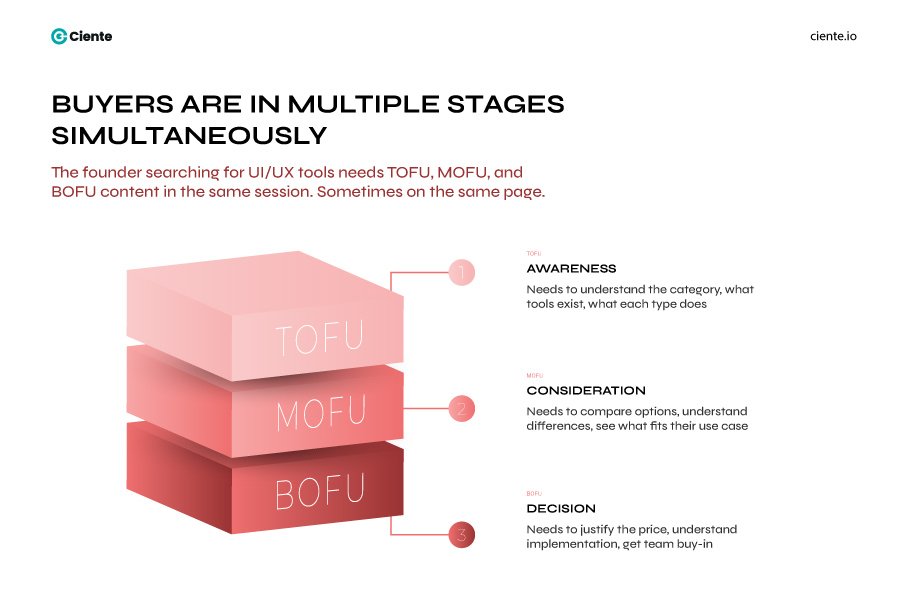
The founder searching for UI/UX design tools needs TOFU content to understand the category, MOFU content to compare options, and BOFU content to justify the price. In the same session. Sometimes on the same page.
If your Figma comparison article is only optimized for the consideration stage, you lose the buyer the moment they realize they need to understand the category first. They bounce. They find a competitor who happened to write something that met them at multiple stages simultaneously.
This is not a content volume problem. It is a content intelligence problem, where the right content formats for SaaS marketing must address multiple buyer needs simultaneously.
The Handoff Assumption Is Where the Money Leaks
The funnel implies clean handoffs. Marketing owns TOFU. Then passes the buyer to MOFU content. Then passes them to sales at BOFU.
Real buyers do not respect handoffs, which is why many teams are rethinking how SaaS marketing lead scoring methods track buyer engagement across different touchpoints.
They read your most technical bottom-of-funnel case study before they have read a single awareness piece. They watch a product demo on YouTube before they have ever visited your website. They talk to someone who has used your product before they have filled in a single form.
When you build marketing operations around clean handoffs that buyers never actually make, you create gaps. Moments where the buyer is ready to move, and the machine has nothing to say to them because they are in the wrong stage according to the system.
That is where deals go quiet. Not because the buyer lost interest. Because the marketing motion had no answer for where they actually were.
How do you optimize the marketing funnel for the buyers?
Stop Thinking About Stages and Start Thinking About Moments
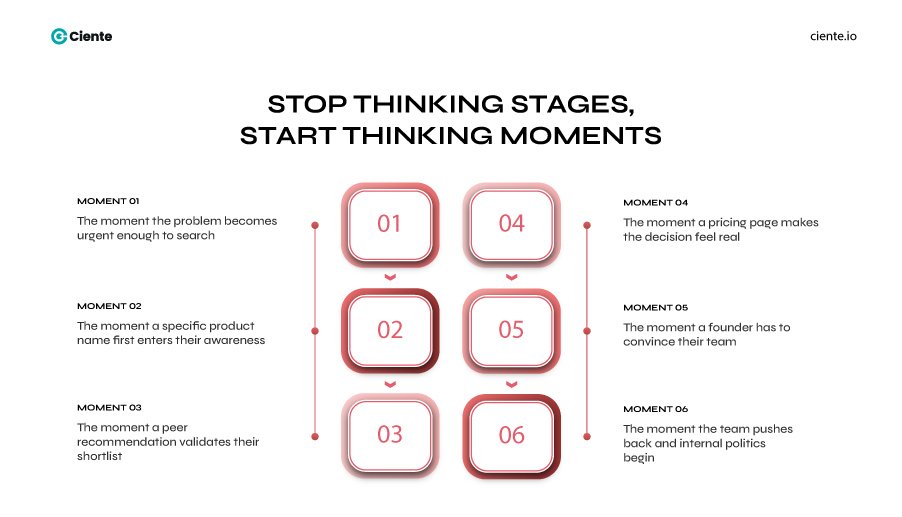
Real buyer journeys are not made of stages. They are made of moments.
The moment the problem becomes urgent enough to search. The moment a specific product name first enters their awareness. The moment a peer recommendation validates their shortlist. The moment a pricing page makes the decision feel real. The moment a founder has to convince their team. The moment the team pushes back.
Each of those moments is a marketing opportunity. None of them maps cleanly to a funnel stage, which is why modern SaaS performance marketing focuses more on intent signals than rigid funnel positioning.
If your content strategy is built around moments instead of stages, you stop asking what stage this buyer is in and start asking what this person needs right now to move closer to a decision.
Those are different questions. The second one produces better answers.
Build for the Complex Journeys
Buyers circle. They come back to things they have already read and read them differently because something changed in their understanding. They revisit a pricing page four times before they contact sales. They read a case study after they have already decided to buy, looking for confirmation that they made the right call.
This is not irrational. It is how decisions actually get made under uncertainty.
Your content needs to serve the buyer on the second, third, and fourth visits with something new to offer. Not just a different angle on the same message, but a deeper level of thinking that rewards the buyer for returning.
Most SaaS content is flat. It has one layer. You read it, you get the point; there is no reason to return, unlike the layered approaches used in many successful SaaS marketing campaigns.
The content that compounds in B2B is the content that rewards re-reading. That has something to offer at the awareness stage and something different to offer at the decision stage, without being two separate pieces. Because the buyer might be at both stages at the same time.
The Channel Is Part of the Journey, Not a Separate Decision
Where a buyer encounters you changes what stage they are effectively in.
A buyer who finds you through a Google search is usually earlier in their thinking than a buyer who finds you through a peer recommendation. A buyer who finds you through a LinkedIn ad is usually more passive than a buyer who comes directly to your pricing page.
The funnel treats all inbound as equivalent once it enters the system. The channel is just an acquisition source. That misses everything.
A buyer who arrives via a trusted recommendation is not aware. They are in late consideration before they have ever visited your website. The content and experience you show that person on their first visit should not be top-of-funnel content. You are wasting the trust that got them there.
Matching the entry point to the experience is where most SaaS marketing teams leave conversion on the table, which directly affects the marketing ROI for SaaS businesses. Because the funnel told them everyone enters at the top.
They do not.
So, do you throw the marketing funnel away?
Do not throw it away.
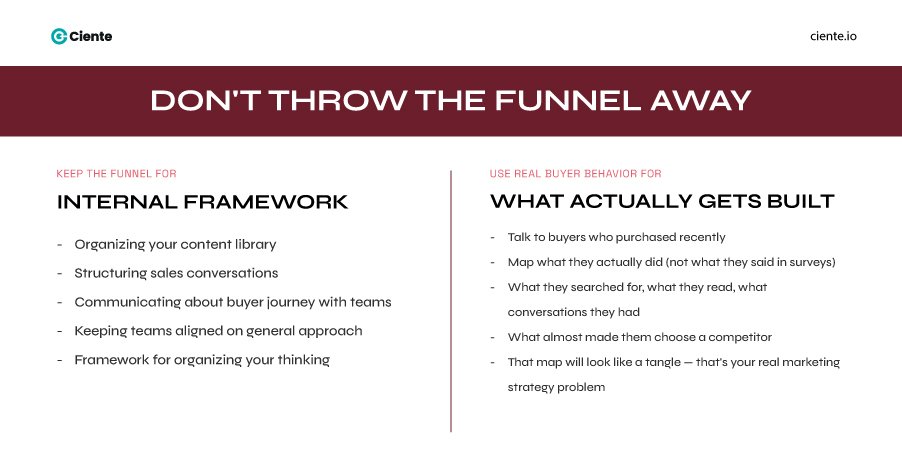
The funnel is a useful internal tool. It helps you organize your content library, structure your sales conversation, and communicate about the buyer journey in ways that keep teams aligned.
Just stop mistaking it for a description of reality.
Use the funnel as a framework for organizing your thinking. Use real buyer behavior as the input for what actually gets built, similar to how many teams refine their B2B SaaS market strategy based on real customer insights.
Talk to buyers who purchased recently and map what they actually did. Not what they said they did in a quick survey. What they actually did. What they searched for. What they read. What conversations they had. What almost made them choose a competitor.
That map will not look like the funnel. It will look like a tangle. And that tangle is your real marketing strategy problem.
The funnel is clean because it’s a concept that is easy to understand. But the buyers are messy, and their journeys are complex because that is how decisions actually get made – in urgency or some strong desire.
Build for the mess. That is where the opportunity is, because almost nobody else is looking there—a mindset that increasingly defines modern SaaS marketing insights for 2026.