
Your SaaS content marketing playbook expired while you counted MQLs. Distribution beats creation. PLG kills thought leadership. Here’s what works now.
Nobody’s going to tell you this, so I will: the content marketing game shifted while you were still counting MQLs.
Walk into any SaaS marketing meeting right now. Same strategy they ran in 2022. Write blogs around keywords. Gate the white papers. Cross fingers for conversions. Then sit confused when organic traffic tanks 40% and lead quality goes to hell.
What happened? The market moved. AI flooded search with mediocre answers. Zero-click results killed traffic before it reached your site. Buyers stopped filling forms- because who wants another nurture sequence? And everyone’s publishing the same templated SEO blogs that ChatGPT spits out in thirty seconds.
But SaaS content marketing isn’t dead. It’s just evolving faster than most teams can keep up. The companies winning aren’t cranking out more posts. They’re publishing different content with a fundamentally different theory about what creates value — the same shift is happening across modern SaaS marketing strategies.
Still measuring wins by blog sessions and MQL counts? You’re optimizing the wrong things. Here’s what actually matters now.
1. Content Distribution Beats Creation (And It’s Not Even Close)
Most SaaS content teams spend ninety percent of their time creating. Ten percent is distributed.
Flip it.
Your best piece might never surface. That killer product comparison you spent two weeks on? Buried on page two. The demo walkthrough that nails your value prop? Sitting unwatched in a Notion folder.
You’re not competing for traffic anymore. You’re competing for fractured buyer attention across a dozen platforms they actually use.
Think about how your buyers consume information. LinkedIn threads. Podcasts on their commute. Newsletters between meetings. Reddit, when they should be working. Slack communities where peers hang out. Your content lives in search results. Your buyers live everywhere else— which is why strong SaaS inbound marketing now extends beyond just ranking on Google.
SaaS companies are cracking this treat every piece as raw material. One founder’s insight becomes a LinkedIn post. That post expands into a blog. The blog compresses into a sales deck. The deck morphs into onboarding content.
This isn’t repurposing for vanity metrics. It’s meeting buyers where their eyeballs actually land- not where you wish they’d land.
And here’s the unlock: founder reach crushes brand reach. B2B buyers trust people over companies. A founder’s hot take on LinkedIn with actual POV will outperform your polished, SEO-perfect blog every single time because it sounds human.
Creation isn’t the bottleneck. Distribution is. If your content plan doesn’t answer ‘where will buyers actually see this,’ you’re building in a vacuum-and no serious B2B SaaS growth marketing strategy ignores distribution leverage.
2. Product-Led Content Kills Generic Thought Leadership
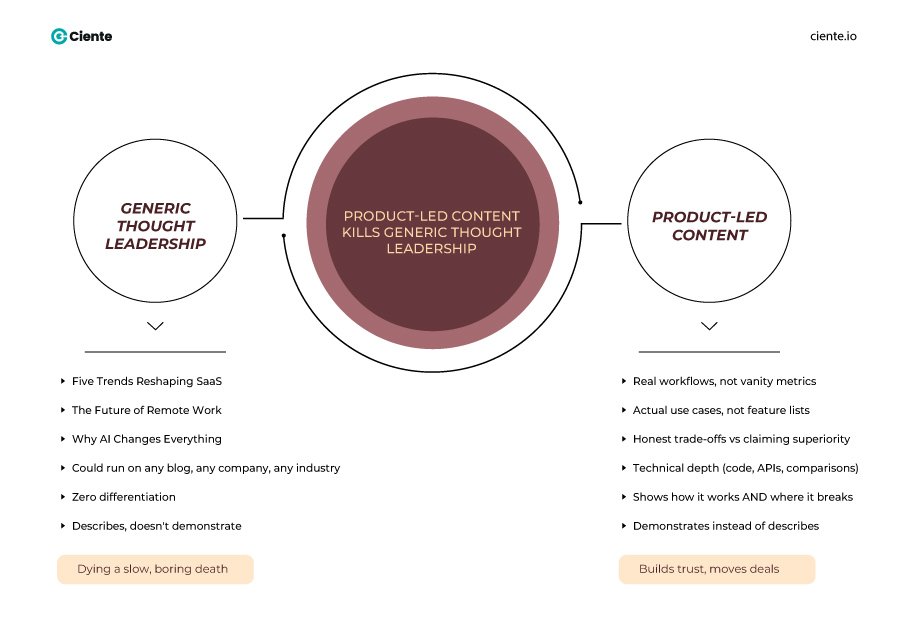
Generic thought leadership is dying a slow, boring death.
You know the posts. ‘Five Trends Reshaping SaaS.’ ‘The Future of Remote Work.’ ‘Why AI Changes Everything.’ Surfaces that could run on any blog, for any company, in any industry. Zero differentiation.
What’s taking over? Product-led content that demonstrates instead of describes— a principle deeply rooted in effective SaaS product marketing.
Your product isn’t the hero here. It’s the vehicle. Gusto’s payroll tax calculator doesn’t pitch payroll software. It solves a real problem and happens to show what the tool can do. Webflow’s design tutorials don’t sell web builders. They teach design, and the tool becomes obvious.
The shift: stop educating, start accelerating decisions.
Buyers aren’t hunting for more information. They’re already drowning in it. Their actual need? Clarity about which solution fits their situation. Product-led content does that by showing, not telling.
SaaS marketing case studies showing real workflows, not just vanity metrics. Product demos walking through actual use cases, not feature laundry lists. Comparison content that honestly addresses trade-offs rather than claiming superiority in everything.
Technical depth matters too. SaaS buyers in 2025 are sharp. Product managers. Engineers. CTOs. They smell surface-level fluff instantly. Don’t water it down. Give them code snippets. API docs. Real technical comparisons that respect their intelligence.
It builds trust faster than any ‘leading platform’ messaging ever will. Show how it works. Show where it breaks. Show the actual decision they’re making. That’s what moves deals.
3. Jobs-to-be-Done Works (When You Actually Use It)
Everyone talks about jobs-to-be-done. Almost nobody uses it correctly for content.
Common mistake: treating JTBD like fancy language for pain points. It’s not. Your customer isn’t hiring your product to solve pain. They’re hiring it to make progress in a specific context.
A Head of Accounting isn’t shopping for accounting software. They’re trying to close books faster without adding headcount. An engineering lead isn’t browsing monitoring tools.
Your content maps to those jobs. Not your features.
Which means SaaS content marketing requires actual customer research. Not surveys asking which features they prefer. Impactful conversations about what they’re trying to accomplish and what’s blocking them.
Sit in sales calls. Mine support tickets. Lurk in their Slack communities. Track the questions prospects ask before they ever hit your demo form. That’s where content gold lives.
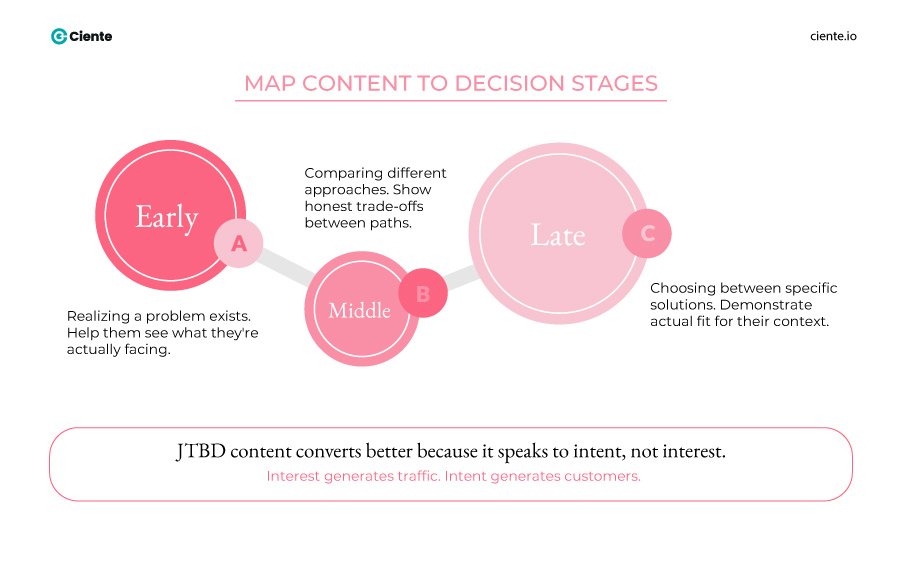
Then build content addressing those jobs at different decision stages. Early: they’re realizing a problem exists. Middle: they’re comparing different approaches. Late: they’re choosing between specific solutions aligning closely with real B2B SaaS funnel conversion benchmarks.
Notion nails this.
It doesn’t sell project management software. Notion shows how to build systems for specific jobs. Creating a help center. Managing sprints. And onboarding remote teams. The software becomes the obvious vehicle for completing the job.
JTBD content converts better because it speaks to intent, not interest. Interest generates traffic. Intent generates customers- big difference.
4. Retention Content is Your Biggest Missed Opportunity
Everyone obsesses about top-of-funnel. Almost nobody thinks about retention content. Backwards.
Acquiring new customers costs five times as much as retaining the current ones. And churn rate impacts growth more than conversion rate. And content is your cheapest retention lever.
But retention content isn’t acquisition content.
Acquisition attracts. Retention enables. The goal isn’t clicks or form fills- it’s users actually succeeding with your product.
That means documentation that actually helps people. Not marketing copy disguised as docs. Real troubleshooting. Real workflow examples. Actual answers to ‘how do I actually do this thing I’m stuck on?’
Zendesk built an entire self-service library. Users solve problems without opening tickets. That’s retention content working. Reduces support load. Improves experience. Keeps customers from churning out of frustration.
Onboarding content matters most. New users who don’t hit activation churn fast. Micro-tutorials. Feature adoption guides. Use case libraries. It should be ungated, searchable, and mapped to friction points you already know exist.
Impactful retention content anticipates where users get stuck and solves it before they rage-quit. Run churn surveys. Ask why people left. That feedback becomes your retention content roadmap.
Most SaaS companies lose customers because users can’t figure out how to use the product effectively. Content fixes that. It won’t win you awards, but it keeps your revenue from hitting rock bottom.
SaaS content marketing in 2026 is about clarity on what creates value.
Distribute more than you create. Show instead of describing. Map to jobs instead of pain points. Enable retention instead of chasing new logos.
These aren’t tactics. They’re shifts in how content actually drives growth. Content isn’t a traffic generator anymore. It’s infrastructure for trust, decision-making, and value demonstration.
The SaaS companies winning with content stopped chasing MQLs. They optimize for customer LTV now. They treat content like product- build it, test it, iterate it, improve it based on what actually works.
If your strategy still looks like 2022, you’re already behind. The playbook changed; it’s time to catch up.