With buyers less vulnerable to short-term pricing gimmicks, trust and clarity have turned out to be the ultimate winners. Demand gen or inbound marketing- which one is your best step forward?
Key Takeaways
- Traditional inbound only catches buyers who are actively searching. But that 5% of the market is noisy, crowded, and expensive. The real long-term pipeline lies in the remaining 95% who aren’t ready to buy today but will be tomorrow.
- Inbound marketing is a single piece of the puzzle designed to capture intent when buyers look for you. Demand gen, however, is the entire revenue engine- amalgamating inbound, paid media, ABM, and outbound to cultivate interest across the buyer journey.
- Showing up once doesn’t cut it now. Demand gen builds brand recall through consistent repetition so that when an out-of-market buyer finally enters their research phase, your brand is the first name that comes to mind.
- Success isn’t about collecting form fills or vanity inbound metrics such as MQLs. It’s about building a sustainable growth model measured by qualified pipeline, lower CAC, and actual closed-won revenue.
- Use outbound to disrupt, inbound to educate, and demand generation to stay top-of-mind so you’re already trusted when they’re finally ready to make a move.
Introduction
Marketing teams are often judged on results. With tightening budgets and skepticism in any marketing function at an all-time high, marketers must prove through numbers and not merely words. And that means hyper-focusing on lead gen.
But here’s a twist: you and your competitors are busy chasing the same 5%. You are having the same conversations, bombarding the same messages, and selling the same value prop.
This 5% is cluttered. And even in any scenario, you’ve got the budget and a really good story to shout out your brand; truly reaching the buyers is then the next detriment.
In this brand recall cold war, even if you get through and capture the mindshare, do you think you’ll stay top-of-mind until your buyers are actually ready to take the next step?
Inbound focuses on that 5%. But what about activating the rest of the 95%?
Demand generation over inbound marketing should be your next step. Or you’ll be losing a great chunk of potential customers waiting on them to take theirs.
Demand generation is gaining traction over just inbound marketing. Why?
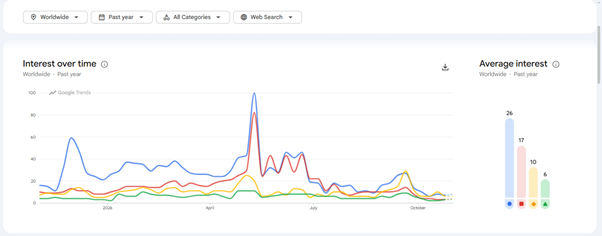
A very simple search on Google Trends offers us a simple idea: many more users are searching for demand gen (blue, red) than they are for inbound marketing (yellow, green). At least in the past year.
Why?
The simple answer: the market has changed.
There’s a huge strategic gap between how brands engage potential customers- and how they truly want to be engaged.
At this point, you might have realized that ‘your’ target market is a small part of the overall market- and not every buyer, even in the same industrial domain, is a potential customer. And that is the nucleus of modern marketing- who your customers really are, and how they behave.
Well, even that has become a problem point. No longer do brands really grasp what their buyers want- and that has left them reverting to broad, volume-based tactics that contribute very little to a healthy pipeline. To sustainable growth.
And amidst this complexity, the Ehrenberg-Bass Institute’s report further tears apart this concept: ‘your’ market is even more fragmented than realized. First, there’s your ICP-fit. And then there’s the propensity to purchase not just yours, but any (similar) solution.
As per EBI, only 5% of your target market is in-market researching for a solution at all times. The remaining 95% are out- maybe not aware of the problem, or just not interested.
Equipped with every tool and software to reach the 5%, too many B2B brands focus on this segment. They are already researching a similar solution as yours, so getting them into the funnel means making a business case for your solution: why you over your competitors.
However, with the same perspective, you and your competitors are in a cold war over the same 5%.
It’s the remaining 95% you need to stay on top of. They’re the right fit, just not ready for an offer, but that doesn’t mean someday they won’t be.
Focusing on reach kills your exposure because, in a saturated market, already weighed down by similar solutions, how far does your message really travel? And even if a buying committee member sees it, do they actually retain the memory of your solution?
Reach has little impact in the modern market.
Capturing mindshare means attacking with frequency. That’s where demand generation comes in. The gradual brand recall it builds across 95% of your target market is why brands have been keen on this.
Demand Generation vs. Inbound Marketing
Demand generation: what and why now
According to HubSpot, demand generation has a simple definition:
“Demand generation is a comprehensive marketing strategy for creating awareness, interest, and desire for your products or services throughout the entire buyer journey.”
Demand generation isn’t lead generation. And it definitely isn’t a top-of-funnel function. Unlike lead generation, it covers everything from brand awareness to customer retention. How? This function relies on cultivating memorability- consistent presence through repetition.
And for B2B brands already operating in an extremely crowded market, getting through might be easier. But making their value stick is what takes the most weight.
Most organizations we talk to face the same problem: making a dent.
Take the cybersecurity space. There’s Fortinet, Barracuda Networks, and Palo Alto offering similar services- and all of them are giants in this space.
The buyers would either stick with their status quo or pivot to another safe option influenced by quality and pricing structure. But what if you have a better product, a better USP? You have two options:
- Merely nurture the 5% your competitors are also focused on.
- Or, activate and also target the rest of the 95%.
Inbound marketing: where and when
Inbound marketing works best for the second audience segment.
Salesforce describes it as “a strategic approach to creating valuable content that aligns with the needs of your target audiences and inspires long-term customer relationships.”
The potential customers, or prospects, are already aware of their problem. They are researching a solution and come across your brand on any channel- from LinkedIn to an Instagram reel or a high-ranking blog piece.
The cream of the B2B demand gen agencies follow a multichannel framework to distill the best results from this tactic. The aim is to be where the buyers are researching- but unlike bought attention, you must show up at the right time with the right message for the buyer to take the right action.
Every content asset is tailored to the audience and the touchpoint where they might be researching solutions.
You might think- but this is outbound too, right? Isn’t this how ads and outreach work?
The power of engagement is within the buyers. If they need that information at the given time, they’ll engage with the content. The exchange is informational. Formats leveraged for this include whitepapers, SEO blogs, opted-in newsletters, and thought leadership.
Inbound remains unintrusive- given the power of engaging (or not) with content remains in the hands of the buyers.
All that you do is become the source of the information they may be seeking out- especially at different phases of their buying journey- by earning trust and becoming the subject-matter expert.
But for outbound, the interaction is forced and often transactional. Think paid ads and cold calls/emails. That’s how brands are stuck with attracting the thin 5% slice- bidding the cost of acquisition up and up.
Outbound ignores that 95%.
So, then inbound is demand generation?
Not really. It is only a part of demand gen- and the rest of it is outbound. Let’s draw a clear distinction.
The clear demarcation between demand generation and inbound marketing
| Dimension | Inbound Marketing | Demand Generation |
| Primary Scope | Focuses on capturing active search intent and inbound traffic. | Focuses on creating new market desire and capturing intent across all touchpoints. |
| Channel Mix | SEO, organic blog, organic social, podcasts, educational landing pages. | Owned, earned, paid media, ABM, events, partner co-marketing, outbound. |
| Primary Metric Focus | Web traffic, content engagement, form fills, Cost Per Lead (CPL). | Qualified pipeline, Sales Qualified Opportunities (SQOs), Customer Acquisition Cost (CAC), Pipeline Velocity. |
Demand creation, capture, and outbound – under the umbrella of demand generation
Demand gen amalgamates inbound and outbound.
As a business owner or marketer, you can’t merely plan for the present. A consistently healthy pipeline also demands planning for the future. That’s how marketing directly supports the bottom line.
But how?
As emphasized before, those 95% out-of-market buyers are going to be searching for a solution sometime or another. You need to be able to show up in those moments. Again, how?
By making your brand memorable- and capturing mindshare. You can’t always push buyers through the funnel- but ‘catch them as they fall.’
In B2B, things are lengthy and complex. And in B2B, buyers are time-crunched and risk-averse- buying committees must make decisions that don’t just impact their career but also the organization’s workflows.
In their research phase, they come across hundreds of brands in small, fleeting moments- unless something is sticky enough to make it to their saved documents or Slack conversation with peers.
This is demand generation, and inbound is merely a segment of it.
Demand generation helps position your brand as a clear solution by educating buyers and building a relationship, and not jumping the gun like with outbound strategies.
You could have the best logos or taglines, but making a brand distinctive doesn’t equate to it being meaningful. In a run for quick sales wins, the role of brand has been completely abandoned- but that’s how brand association and knowledge retention pave the way for actual growth.
Earning space in your customer’s mind is what makes the whole difference- this is what cultivates trust through the uncertainty.