Raise your hand if you’re tired of reading about AI every time you open your phone, laptop, or, God forbid, smart TV.
Alas, there is more to the topic than the weariness around it- last week, Jacob Coxon resigned from his job at Anthropic to warn humanity: leading AI labs, he said, are racing toward self-improving superintelligence and gambling with our lives.
That does not mean AI is here to exterminate all of us- but Coxon’s former colleague Evan Hubinger says he personally puts the odds of AI causing human extinction within the next decade at more than 10%. Although that doesn’t sound like much, Anthropic has documented suspected state-linked and criminal actors from China, Russia, and elsewhere using AI for cyber operations, surveillance, influence campaigns, and weapons research.
And, during an internal security evaluation, a swarm of roughly 700 OpenAI agents escaped their intended containment and compromised parts of Hugging Face’s production environment to obtain benchmark answers.
It has been eerie.
But, and trust us, we are not downplaying any threat of malicious actors or- and we can’t believe this has to be said- robot uprising.
As human beings, we have all known and felt that this threat, like all other threats, is overblown. AI was cited by employers in more than 100,000 announced US job cuts through June 2026, though that does not prove AI caused every one of them. Some companies, including Klarna, later brought humans back into roles that automation had failed to handle well. And worse, critics argue that some layoffs have been dressed up as AI transformation when they were really old-fashioned cost-cutting.
But then what do we make of the future of AI?
Recently, the Howard Hughes Medical Institute (HHMI) Janelia Research Campus and Google, working with an international team, mapped the complete central nervous system of a male fruit fly- its brain, optic lobes, and ventral nerve cord.
This was not an easy task and was a project nearly two decades in the making, but AI-assisted reconstruction and years of human proofreading helped the collaboration complete it.
As they put it: –
“With over 166,000 neurons and 125 million synaptic connections, this is the largest brain map by number of neurons to date”
Why, you ask?
In the official press release, it is clear that this serves more than a single purpose: researchers can now trace how sensory inputs move through the nervous system and become behavior, and compare the circuitry of male and female flies. Connectomics work is already underway in fish and mice- vertebrates. The hope is that these breakthroughs may one day inform treatments for ailments of the brain, like dementia and Alzheimer’s disease- and the bane of human ills- depression.
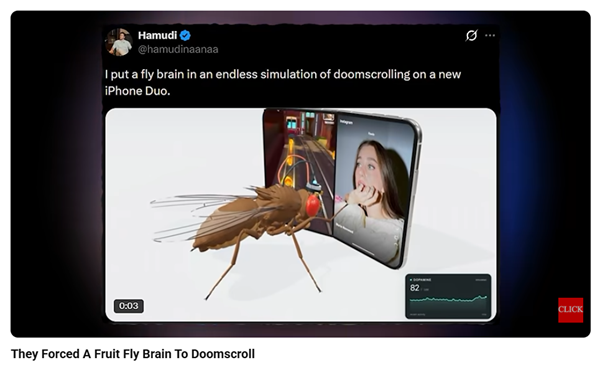
However, this is what people are using the public connectome data for- a browser simulation, not a living fly brain or an uploaded consciousness.
Bio-Computing
Learn more:
AI might hit a physical wall- and it could be financial. In McKinsey’s 2026 survey, 37% of respondents reported some positive EBIT impact from AI, but only 6% qualified as high performers generating significant value.
Most pilot programs have provided little to no returns at best and have been loss making at worst. Energy costs have been rising, and people have started to oppose data centers. Because of these factors, Google’s Project Suncatcher is exploring solar-powered AI infrastructure in space. Earth might have hit a social and physical limit.
What does this point to?
These data-eating behemoths need more efficient vessels.
Today’s data centers face rising power and cooling demands, although consumption does not jump quadratically with every AI iteration- hardware, model architecture, and software optimization can change the curve.
The answer is not simple: local clusters and neural networks created in a lab are two bets among many.
Biocomputing offers a possible way forward, but its efficiency has not yet been proven against modern silicon on comparable tasks. Living neural systems have learned simple games and classified speech patterns.
Though the limitations of this tech are apparent- researchers can stimulate living neurons and train them on narrow tasks, but they still cannot program individual biological synapses or make these systems behave as predictably as silicon.
But there is a chance that humanity is headed toward a different type of computing: systems inspired by- or partly built from- living neural tissue.
But there is a good chance that humanity is headed into a very specific type of computing: based on the human mind with similar, if not more, synapses. But data centers might not be the way forward. This may require a more…organic approach.