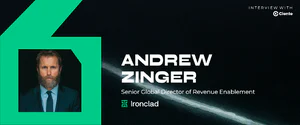
1. As cybersecurity ecosystems scale across global markets, partner networks often risk diluting core capabilities. Owing to the complex nature of multi-layered channel architectures, is there a foundational framework channel leaders can enforce to preserve global brand integrity and consistency?
Whether you’re on the vendor side or the channel/consulting side, the throughline is the same: understand the legacy technology landscape, be proactive in understanding the capabilities of the rapidly shifting innovative tech space…meaning, become as knowledgeable as humanly possible on AI capabilities and what actually makes all of that “magic” work. Above all else, keep your focus on the people you are supporting. That’s what keeps you oriented as the ecosystem scales.
The trap most channel leaders fall into is defaulting to how things have always been done, and a lot of that was task-oriented and transactional. I had the fortune of great leadership and mentorship at a young age, when I was luckily inexperienced enough not to know how everyone else was doing it, and they gave me the freedom to “just figure it out.” That instinct, to ignore the established playbook and ask fresh questions, still applies today. At every opportunity, ask the customers you serve what their job actually requires of them, what their goals are, how their organizations really operate. That’s where you find out how you add value, and then you use every strength in your organization to bring resources into the ecosystem. Don’t be afraid to create something new that serves this time of exploration and learning we’re all in.
AI transformation is not like cloud adoption or shifting to support remote workers like we did during Covid. AI has shaken the ground so fundamentally that we all need to be critical thinkers, and lean in on everything that makes us human so we can help our partners and their end users navigate a completely new way of interacting with technology. Creativity is the differentiator right now, and value can be created by remembering how to learn something new, and then guiding others on that path. Now is the time to be the world’s best “helper,” and that will create the foundation for lasting partnerships.
2. Aligning disparate field teams with standardized GTM motions demands streamlining corporate strategy with regional execution. How have you ensured transparency across global tiers to eliminate internal friction, without stripping away the localized agility your partners depend on?
GTM and channel is, at its core, “sales.” In my last role, leading global strategy and GTM for a large GSI, my primary objective was to streamline and standardize what priorities we served, the associated services, and the messaging we brought to clients and our vendor community alike.
In the simplest terms, my north star has always been “know your audience.” You can build a universal value proposition that drives the same outcomes across the globe, different regions, different markets, but the path to get there, and the framing of the messaging, has to align to the region you’re serving.
For example, say you’re selling a product that addresses GRC. You can’t speak the same language to a financial institution grounded in New York as you would to one based in Japan.
The messaging has to align to the culture of the region; the capabilities and technology have to account for language, business culture, which discovery questions are socially acceptable, and the different policies and realities of doing business in that market.
Look at the outcomes you’re driving, then work backwards to tune them to the region you’re serving. Standardization isn’t about forcing every region into the same script, it’s about holding the outcome constant while letting the path flex.
3. The unbridled proliferation of automated content and standardized frameworks threatens to commoditize partner ecosystems. How must global alliance leaders reiterate their standards for strategic value to avoid settling for partnerships that’re theoretically sound but lack potential for commercial execution?
This comes back to creating real opportunities to listen to what customers need, and understanding the verticals you’re working within. It’s easy, especially as you move up into leadership, to get too far from your customers and the conversations happening at the field level. We can accidentally fall into an echo chamber of other vendors and marketers, and that echo chamber skews our strategic decisions on what outcomes we prioritize for integrations.
We have to challenge ourselves to get back to reality. Instead of asking our peers what they think, we need to listen to what our customers are actually struggling with. It’s pretty incredible how quickly you can solve problems by integrating technologies when you let real customer challenges drive your alliance decisions, instead of letting the business alliance drive what you push out to your customers.
That means getting a real sampling of the annoyances and seemingly insurmountable problems practitioners face in each vertical, and in each business unit within the security team, and digging into the “why” behind the common technology roadblocks the industry has grown comfortable accepting. That’s where the real problem-solving starts, not in the partnership deck, but in the practitioner’s day-to-day frustration.
4. High-growth security companies often encounter a wall where aggressive enterprise demands clash with the modular simplicity characteristic of broader partner ecosystems. What do you anchor the global narrative to so neither growth nor partner loyalty is compromised?
To win in today’s landscape, technology has to be impressive, but it also needs to be easily consumed and understood. In the world of AI-native technologies, tuning and expertise can’t be compromised, or you’ll end up with my least favorite phrase in technology right now: “AI slop.” If you slap something together just because it sounds and looks good at first pass and is easily repeatable, you get a “good from far, but far from good” outcome.
The biggest initiatives right now are around fully transforming the technologies that security teams interact with daily, and because of this, implementations are being scrutinized more than ever. Put yourself in your customers’ shoes: this is change at mass scale. It’s akin to regular cars no longer being available -you have to pick “the best” self-driving car, whether you’re ready or not, and you’d better hope it works. That comes with real risk. Unfortunately, adversaries are innovating too fast for security teams to have the luxury of sticking with what they are comfortable with, and they have no choice but to operationalize a fundamentally different machine, and they have to do it right now.
There aren’t shortcuts here, and everyone in our ecosystem carries the weight of responsible AI deployment and adoption. When working with partners, granularity and deep expertise shouldn’t be viewed as a door that shuts them out, it should be embraced as access. Access to expertise, to over-the-shoulder learning, to flexing a new muscle: resourcefulness. Bringing in the best experts they can get their hands on, while learning alongside the rest of the industry how to implement these new technologies. It’s the key to moving from an observer of AI innovation to a driver.
Growth doesn’t have to come at partners’ expense if you treat complexity as something you bring partners into, not something you gate-keep. The enterprise demand for depth becomes the very thing that makes partners more valuable, not less.
5. Explicit pre-sale validation as well as joint enablement are non-negotiables for technical alliances centered on cybersecurity. Across which scenarios can repeatable playbooks prove limiting, especially in mapping partner-led motions to enterprise conversions?
Playbooks are essential – I couldn’t imagine onboarding a new partner or talking to a customer for the first time and not having a general guide on the value proposition, use cases, differentiators – all of that good stuff. They give us a starting point, a shared language, and a fast way to get up to speed. It’s more of an introduction and baseline – rather than the meat of the sales cycle. The biggest and most successful deals I’ve ever closed look more like group work. It’s not a vendor selling to a customer with a partner standing nearby. It’s the vendor, the partner, and the customer all working together – preferably with shared project management documents, and the deal typically moves at the speed of our collaboration.
A good playbook looks a lot like a working document, not a script: a set of questions that help you, your partner and your customer nail down the actual priorities together. We set the stage with the “what and why” of the technology, which qualifies our fit, but the real work is in the process. You have to understand their business: What decisions need to flow and in what order? What documentation is needed, who owns what, who approves what? What are the typical bumps in the road that we can avoid together? Technical: What does their current architecture look like? Anything particularly weird you guys built yourself that doesn’t play well with others? How are the practitioner teams siloed? How do the teams communicate and collaborate with each other day to day? That’s the human integration work, and it matters as much as the technical integration.
At the same time, you need a strong thesis: what’s the most important outcome for this project? Sometimes the customer already knows. Often, your job is to help educate them toward an ideal outcome, based on where they actually are today and the art of the possible, but that outcome has to have real executive support behind it, or it dies in committee. Once you have that thesis, you build a tactical plan with a scope and timeline to test the most critical use cases, the ones that get them to value fastest.
Overly rigid playbooks break down in complex deals, because opportunities live or die by discovery, and a script can’t adapt to a room with four different stakeholders, a regulated industry, or a technical environment nobody anticipated. The best partner-led motions treat the playbook as a foundation, not a finish line: the questions you always ask, paired with real knowledge of the capabilities and value, so the vendor, partner, and customer have a solid framework to actually nail the project together.

Traci Byrne, Head of Global Channels and Alliances at Cogent
Traci Byrne is the Head of Global Channels and Alliances at Cogent Security, where she leads the global ecosystem strategy to accelerate the adoption of AI-native enterprise security platforms. With over 15 years of experience in cybersecurity and go-to-market execution, Traci bridges the gap between emerging AI innovation and the complex, practical requirements of modern enterprise infrastructure. Previously serving as the Head of Global Security Strategy & GTM at World Wide Technology (WWT), she is a respected industry voice and advisor known for helping organizations navigate the transition from AI experimentation to resilient, production-grade defense. Traci is a frequent host and guest of executive forums focused on the future of cybersecurity, operational resilience, and the strategic leadership required to secure a rapidly evolving AI-driven landscape.