
The B2B technology landscape is currently drowning in a dangerous software fantasy: the belief that artificial intelligence will soon hand-serve closed deals to revenue teams on a silver platter.
According to this hype loop, generative agents will autonomously prospect, qualify, draft every touchpoint, diagnose buyer sentiment, and close enterprise contracts while human operators sit back and monitor dashboards.
This misunderstands the nature of modern enterprise purchasing.
An enterprise sales interaction is an environment of pure human entropy. Buying committees are multi-layered, risk-averse, and deeply sceptical.
Modern buyers possess sharp pattern recognition; they recognize when they are being managed by an automated workflow or an account executive reading from a generated script. The moment a deal encounters political friction, security hurdles, or technical scrutiny, fully automated systems collapse because they lack real-world contextual judgment.
AI will not sell for you. It will not build trust, handle a hostile procurement panel, or navigate delicate internal politics.
When enterprise growth engines treat AI as a replacement for human skill rather than an amplifier of human precision, they do not accelerate revenue-they simply flood the market with derivative, low-friction noise that alienates buyers before a live conversation even begins.
2. The Flash Card Paradigm: Bridging Knowledge Gaps in Real Time
To make AI deal intelligence a true driver of growth, revenue teams must replace the “silver platter” myth with the Flash Card Paradigm.
In a live deal environment, a seller does not need a 50-page analytical report, nor do they need an intrusive, automated assistant shouting generic advice into their workflow. What they need is high-density, context-aware clarity delivered at the exact moment of execution.
Think of AI deal intelligence as a strategic flash card: a concise, real-time snapshot designed to bridge the immediate knowledge gap between buyer intent and seller execution.
When a seller enters a key review or prepares for a pivotal call, the deal intelligence engine should surface three distinct flash cards:
- The Intent Flash Card: Exactly what this specific buying committee did over the past 48 hours (e.g., “The Security Lead spent 14 minutes on the API compliance page; the CFO re-opened the ROI model twice.”).
- The Boundary Flash Card: The exact capabilities and limits of the product relative to the buyer’s legacy infrastructure, preventing the rep from overpromising in the flow of conversation.
- The Proof Flash Card: The single, verified data point or customer case study that addresses the buyer’s precise technical objection.
By structuring intelligence as rapid flash cards, the seller retains complete conversational flow and authenticity while possessing the exact information needed to address the buyer’s concerns.
3. The Star Wars Guidance System: Real-Time Precision in the Trench
The clearest conceptual model for effective AI deal intelligence comes from classic cinema: The Star Wars targeting computer.
When Luke Skywalker flies his X-Wing down the Death Star trench, the targeting computer does not pilot the starfighter. It does not pull the trigger, and it does not dodge incoming fire. The pilot remains entirely in control of the ship, navigating the chaotic, unpredictable environment of the trench.
What the targeting computer provides is a heads-up display (HUD)-a real-time guidance system that calculates distance, vectors, and timing, surfacing the exact moment to take aim and fire.
In modern sales operations, the live deal is the trench run. It is fast, messy, and filled with unexpected obstacles.
An effective deal intelligence platform acts as that targeting computer. It sits quietly in the background of the go-to-market engine, continuously processing unstructured data-meeting transcripts, content engagement metrics, stakeholder involvement, and historic win/loss patterns.
It does not take over the controls. Instead, it illuminates the target:
- It warns the seller when a deal is single-threaded (only talking to one champion while the rest of the committee drifts away).
- It highlights when messaging drift occurs (the seller is pitching features while the buyer is asking about risk mitigation).
- It signals the precise window of opportunity to introduce commercial terms based on observed buyer engagement.
The human seller remains the pilot. The AI provides the targeting vector.
4. The Architecture of Precision: Intent, Horizons, and Evidence
To operationalize this guidance system, growth and enablement leaders must move away from static CRM hygiene metrics and anchor their deal intelligence architecture around three operational layers:
1. Intent Telemetry over Activity Logging
Traditional management tracks activity metrics: How many emails were sent? How many calls were logged? This approach measures rep motion rather than buyer momentum.
AI deal intelligence shifts the focus to buyer telemetry. It aggregates unstructured interactions across digital channels to tell the seller how the account is reacting. If three new stakeholders from the client’s legal team suddenly view an integration document, the system surfaces that signal immediately, allowing the rep to proactively engage the new decision-makers.
2. Product Horizons over Fixed Scripts
When reps feel cornered during a live call, they frequently overpromise product capabilities to salvage the opportunity.
AI deal intelligence acts as an instant reference map, defining what the product does out-of-the-box, what requires custom configuration, and what resides on the future roadmap. Reps can speak with complete authority on product capabilities without needing to pause the call or check with sales engineering.
3. Proof Validation over Marketing Fluff
The most common point of deal failure occurs when a rep makes a bold value claim but cannot back it up with empirical evidence.
A guidance-focused AI system dynamically links buyer objections to concrete proof points. If a prospect questions implementation timeline risks, the platform instantly surfaces the exact deployment data from a peer company in the same industry.
5: Passive Dashboards vs. Real-Time Guidance HUD
To understand where your organization sits on the GTM maturity curve, compare standard sales intelligence implementations against a reality-grounded guidance HUD:
| Operational Dimension | The Passive Dashboard Approach | The Real-Time Guidance HUD |
| Primary Function | Storing historical activity data for management reporting. | Delivering actionable context directly to the seller in the flow of work. |
| Seller Experience | Reviewing complex, multi-tab analytics dashboards before a call. | Receiving concise flash cards highlighting buyer intent and deal risks. |
| Deal Risk Detection | Identified late during pipeline review meetings after momentum has stalled. | Highlighted immediately when engagement drops or key stakeholders go silent. |
| Content Deployment | Reps search static repositories for generic marketing decks. | The system recommends dynamic proof points mapped to active buyer objections. |
| Execution Focus | Enforcing strict compliance with qualification checklists (e.g., BANT). | Empowering sellers to adapt fluidly to live buyer signals. |
6. Execution at the Margin: Hitting the Thermal Exhaust Port
Commercial growth is rarely won by grand strategic shifts executed on paper; it is won at the margins of daily sales interactions. It is decided in the 45-minute live call where a seller either connects with the buyer’s true operational pain or falls back on generic corporate pitches.
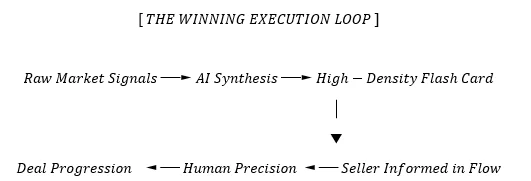
AI deal intelligence is not an automated autopilot designed to eliminate human sellers. It is a precision targeting computer designed for an environment characterized by entropy and noise.
When growth leaders strip away the marketing hype and build an intelligence engine focused on timing, context, and flash-card clarity, they give their teams a decisive operational edge:
- Sellers stop guessing what buyers care about, using real behavioral data to guide conversations.
- Managers stop inspecting activity metrics, focusing their coaching efforts on active deal dynamics.
- Marketing assets transition from unused collateral into active proof points used to secure buy-in.
Give your sellers complete command of the cockpit. Equip them with a targeting system that cuts through the noise, illuminates the objective, and allows them to execute with precision when it matters most.