
The focus of SEM strategies used to be chasing clicks. But moving the needle requires a genuine, human understanding of their pain points. How do you connect your antisocial buyer to the solutions that would actually make a difference?
Key Takeaways
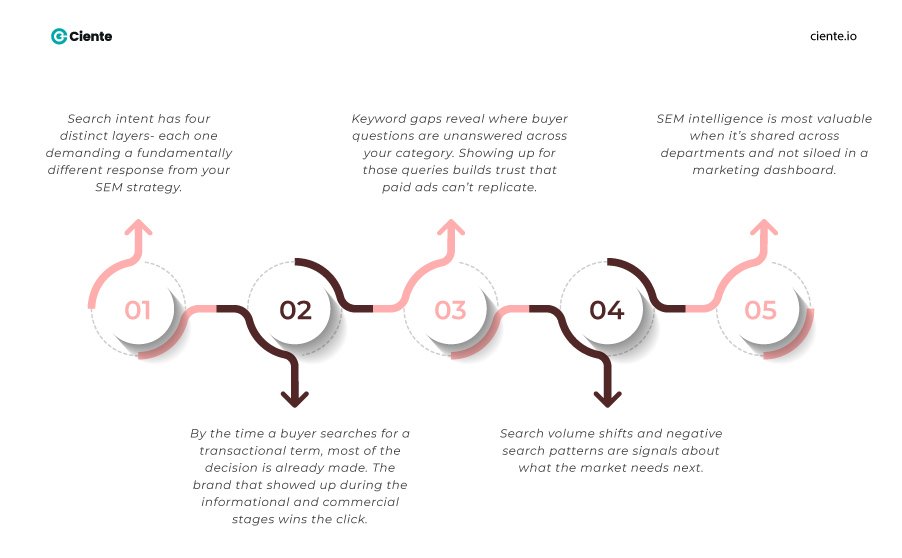
SEM strategies are built backwards.
They start with the product, build a keyword list around it, write ads that talk about features, and point everything at a landing page optimized for conversion. Then they wonder why the click-through rate is decent, and the pipeline is thin.
The problem isn’t the bidding strategy. It isn’t the ad copy. It’s that the entire program was designed around what the company wants to say rather than what the buyer is actually trying to find.
Search engine marketing intelligence flips that logic. It starts with the buyer’s question, traces their path, and builds the entire search strategy around meeting them at the right moment with the right answer. Not a pitch. An answer.
That distinction is the whole game in B2B SEM right now.
What Search Engine Marketing Intelligence (SEM) Actually Is
Search engine marketing intelligence is the practice of using search data to understand buyer intent, map it to the buyer journey, and build campaigns that serve the right message to the right person at the right stage of their decision-making process. This approach becomes even more effective when aligned with a well-defined SEO funnel.
It goes further than keyword research. Keyword research tells you what people are typing. SEM intelligence tells you why they’re typing it, where they are in their evaluation, and what they need to see next to move forward.
A buyer searching “what is revenue operations” is in a completely different place than one searching “best RevOps software for mid-market SaaS.” Same broad topic. Completely different intent. Completely different jobs for the ad, the landing page, and the follow-on experience.
Most SEM programs treat those two searches almost identically. That’s where the budget disappears without producing a pipeline.
Why Buyers Get Lost in the Search Experience
Here’s something worth sitting with. A buyer with a genuine problem and actively searching for a solution can still walk away from a search session more confused than when they started.
It happens constantly. They search for a question. They get ads selling products they’re not ready to evaluate. They click a landing page that assumes they already know what they need. They bounce. They try a different search. They land on a competitor’s blog that actually explains the problem. They start forming opinions. Not necessarily about who has the best product- about who understands their situation.
That moment, the one where a buyer decides who gets their trust, almost never happens on a product page. It happens on a piece of content that answered a real question without asking for anything in return.
Search engine marketing intelligence is what tells you where those moments are, what questions are being asked, and how to show up for them before a competitor does. As search behavior evolves, businesses must also understand the shift from traditional SEO toward answer engine optimization.
Reading Search Intent Before You Build a Single Campaign
The Four Layers of Search Intent in B2B
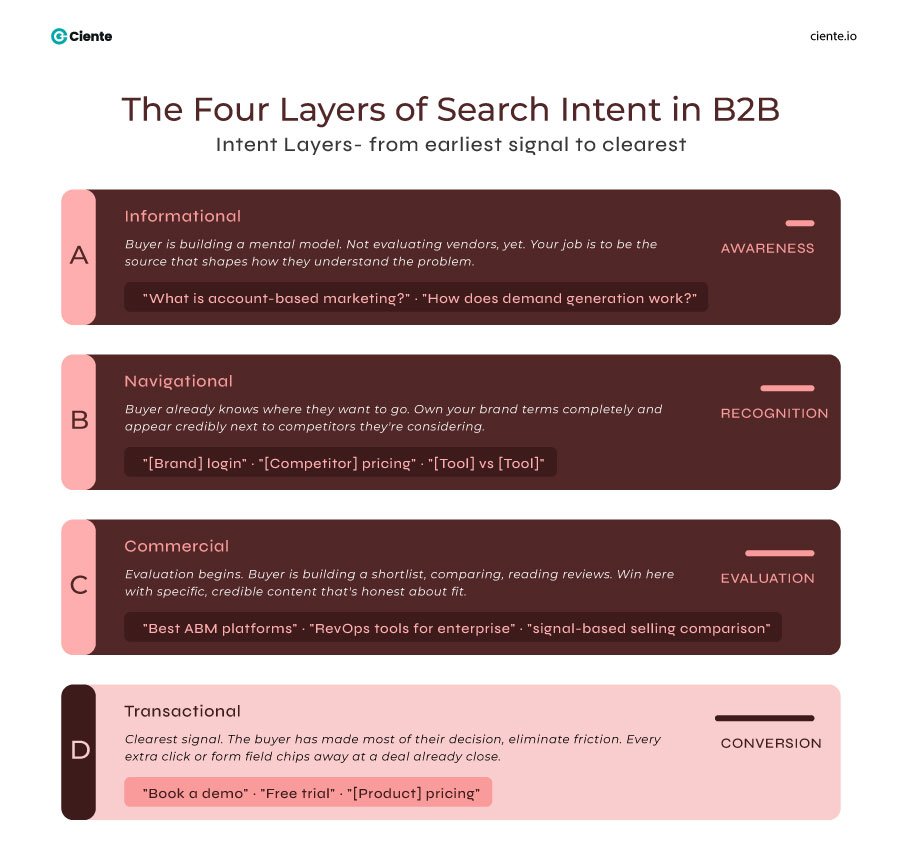
Search intent in B2B isn’t binary. It doesn’t just split into “awareness” and “purchase ready.” There are at least four distinct layers, each requiring a different response.
A. Informational intent is the earliest signal.
The buyer is trying to understand something. “What is account-based marketing?” “How does demand generation work?” “Difference between first-party and third-party data.” They’re not evaluating vendors. They’re building a mental model. The job here isn’t to sell. It’s to be the source that shapes that model.
B. Navigational intent is when a buyer already knows where they want to go.
They’re searching for a specific brand, a specific tool, a specific resource. Your job at this stage is to own your own brand terms completely and, where possible, show up credibly aligned with competitors they’re already considering.
C. Commercial intent is where evaluation begins.
“Best ABM platforms.” “RevOps tools for enterprise.” “Signal-based selling software comparison.” The buyer is actively building a shortlist. They’re comparing. They’re reading reviews. They’re looking for social proof. The content and ads that win here are specific, credible, and honest about what you’re good at and who you’re right for.
D. Transactional intent is the clearest signal.
“Book a demo.” “Free trial.” “[Specific product] pricing.” The buyer has made most of their decision. Friction is the only thing left to eliminate. Every unnecessary click, every form field that doesn’t need to exist, every landing page that doesn’t immediately confirm they’re in the right place, chips away at a deal that was already close.
Why Most SEM Programs Only Show Up at the Wrong Layer
The natural instinct is to invest where the intent is most explicit. Transactional terms convert. They’re easy to measure. They make the quarterly report look clean.
What that approach ignores is that by the time a buyer searches for a transactional term, they’ve already formed most of their opinion.
The brand they trust most, the vendor who explained the problem best, the company whose thinking they encountered three weeks ago during the informational phase- that’s who wins the transactional click most of the time. Not the one who bid the highest on the bottom-funnel keyword.
SEM intelligence says: map the full search journey. Invest across all four layers. Win trust early. Show up precisely when the evaluation gets serious. And make the transactional moment as frictionless as possible for a buyer who already likes you. This full-funnel approach closely mirrors how successful lead generation engines are built.
How Search Data Tells You What Buyers Actually Need
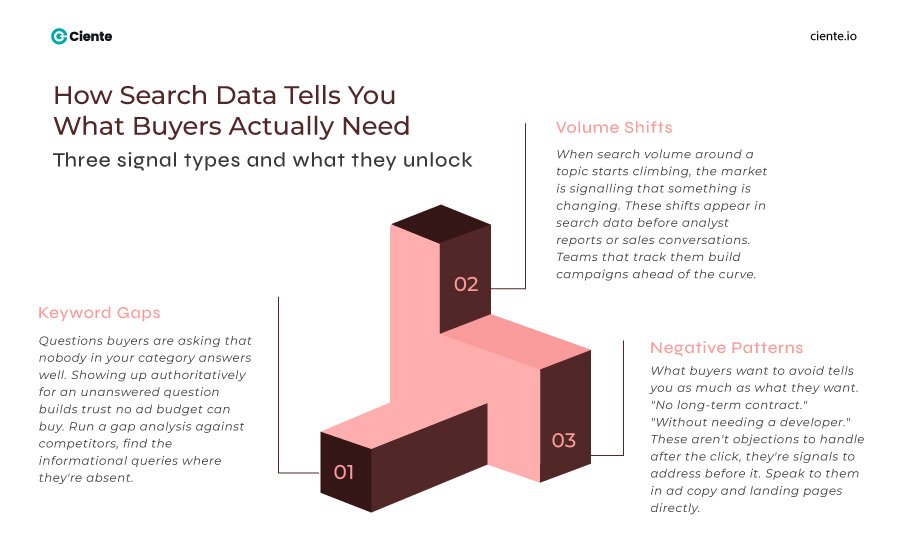
Keyword Gaps Reveal Unmet Needs
The questions buyers are asking that nobody in your category is answering well- those are the highest-value opportunities in SEM. Not because the search volume is always massive, but because showing up authoritatively for an unanswered question builds the kind of trust that paid ads can’t buy.
Run a gap analysis against your top competitors. Find the informational queries where they’re absent or where the existing content is weak. Build something genuinely useful for those searches. Many teams now use AI SEO tools to identify these opportunities faster and at greater scale.
The buyer who found their answer on your page, before they were ready to evaluate anyone, will come back when they are.
Search Volume Shifts Signal Category Momentum
When search volume around a specific topic starts climbing, that’s the market telling you something is changing. Tracking these shifts is becoming increasingly important as AI in digital marketing continues to influence buyer behavior and search patterns. A new regulation is making a previously niche compliance question suddenly urgent. An industry trend is creating a problem that buyers didn’t have two years ago. A competitor’s product launch is generating curiosity about a capability buyers didn’t know they wanted.
These shifts show up in search data before they show up in analyst reports or sales conversations. Teams that monitor them build campaigns ahead of the curve. The ones that don’t find themselves bidding on expensive terms that have already been claimed by someone who got there first.
Negative Search Patterns Are as Valuable as Positive Ones
What buyers are explicitly trying to avoid tells you as much about their decision criteria as what they’re looking for. “No long-term contract.” “No implementation fee.” “Without needing a developer.” These aren’t objections to handle after the click. There are signals to address before it.
Landing pages and ad copy that speak directly to the concerns embedded in a buyer’s search query convert better. Because they demonstrate something more important than a feature list- that the company understands what the buyer is actually worried about.
Making Search Engine Marketing Intelligence an Organizational Asset
Product Teams Need to See It
Search data is one of the most underused inputs in product strategy.
The questions buyers are searching for that your product doesn’t answer cleanly are a roadmap signal. The language buyers use to describe the problem they’re trying to solve is positioning intelligence. The features competitors are searching for that you’re not showing are where the category is moving.
Most product teams perceive SEM reports as a marketing artifact. The ones integrating search intelligence into roadmap conversations are building with a clearer view of where buyer expectations are heading. This cross-functional visibility is a hallmark of a strong B2B revenue engine.
Sales Teams Should Know What Brought a Prospect to You
When a prospect engages after a search journey, the path they took matters. Someone who found you through an informational query and spent three weeks reading your content is a very different conversation than someone who searched your brand name directly.
The former needs trust confirmed. The latter needs friction removed.
SEM intelligence integrated with CRM data gives sales reps context they’d never have otherwise. That context changes the first call. It changes the follow-up. It changes the close rate, quietly and consistently.
Content Strategy Should Be Built on Search
Most B2B content strategies are built around what the marketing team thinks is interesting or what the brand wants to talk about. Search intelligence builds content strategy around what the market is actively trying to understand. This is especially important for companies focused on SEO for SaaS growth.
Those are not the same thing.
The intersection, i.e., where what the buyer is searching aligns with what the brand has genuine expertise in, is where the highest-value content lives. That content compounds over time. It drives organic traffic, earns backlinks, builds topical authority, and reduces paid spend on informational queries over months and years.
The Buyer Doesn’t Know They Need SEM Intelligence. They Merely Know They Need an Answer.
Here’s the frame that changes how this whole function gets built.
The buyer searching for a solution isn’t thinking about marketing strategy. They’re thinking about a problem. They have a question. They went to Google with it. They’re hoping the next click gives them something useful. Increasingly, those answers are being surfaced through AEO and GEO strategies alongside traditional search.
The brand that built its SEM strategy around answering that question clearly, at the right moment, in the right format- that brand wins the trust. And in B2B, trust is what closes deals. Not the highest bid on the most competitive keyword.
Marketing intelligence platforms is the practice of building that trust systematically, at scale, across the full search journey.
Most companies aren’t doing it. That’s not a criticism. It’s an opportunity.