
Can communities, livelihood, and the environment be rendered expendable in pursuit of technological progress?
“Residents are using words like silenced, ignored, secretive, and not seen and not heard.”
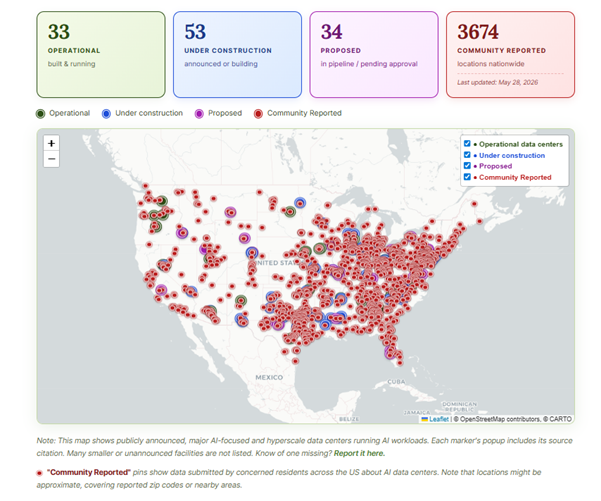
Erin Brockovich has built a website focused on transparency surrounding data center construction, with over 3,674 community reports in just two months. And yes, it’s the same consumer advocate who single-handedly built a massive case against Pacific Gas & Electric Company back in 1993.
This website is basically an archive, and its most intriguing aspect is the map showing all data centers that are up and running/being constructed/planned/pending approval across different states in the US. And it offers the one thing that resides at the crux of Brockovich’s argument: if data centers are so critical to our development, why are they being built in secret?
That’s also the premise of her Substack piece.
In CBS’s halftime report, Oracle’s CEO, Clay Magouyrk, reinstitutes what we’ve been hearing from tech leaders ever since AI materialized (maybe even before that): the faster that AI data centers are built and scaled, the faster American life will improve.
Again, Magouyrk’s statement reinforces Brockovich’s thesis. If the universal claim is that data centers are for the overall betterment of the global community, why is the community being left out of the conversation?
Because the ground-level reality of data center construction disagrees with the disposition of these technologists and leaders. One that’s overlooked because it doesn’t directly contribute to their interests.
You see, there’s a simple spectrum to be observed here.
The Divergent Perspectives
A. The Lawmaker Sentiment
On one side are the promises of more jobs, more revenue, and better economic opportunities for the local communities. For example, Google’s data center located in central Ohio pays over $64k to a technician and more than $160k to an operations manager. There are well-paying and permanent opportunities to be found here.
Similarly, for state and local governments, it’s the most sought-after channel to gain revenue through property, sales, and even use taxes. So much so that AI data center construction has become an economic battleground for states. Several lawmakers across multiple cities and states are offering sizable incentives to attract data center construction to their land.
The data center projects are being put up on a podium, as an auction, and the state with the highest bid will secure the project.
Louisiana was one of the recent states to win a data center project, Meta’s Hyperion. According to the tech giant, it’s the largest data center, precisely 4 million acres, ever built across the entire Western Hemisphere. And to offer you some perspective-
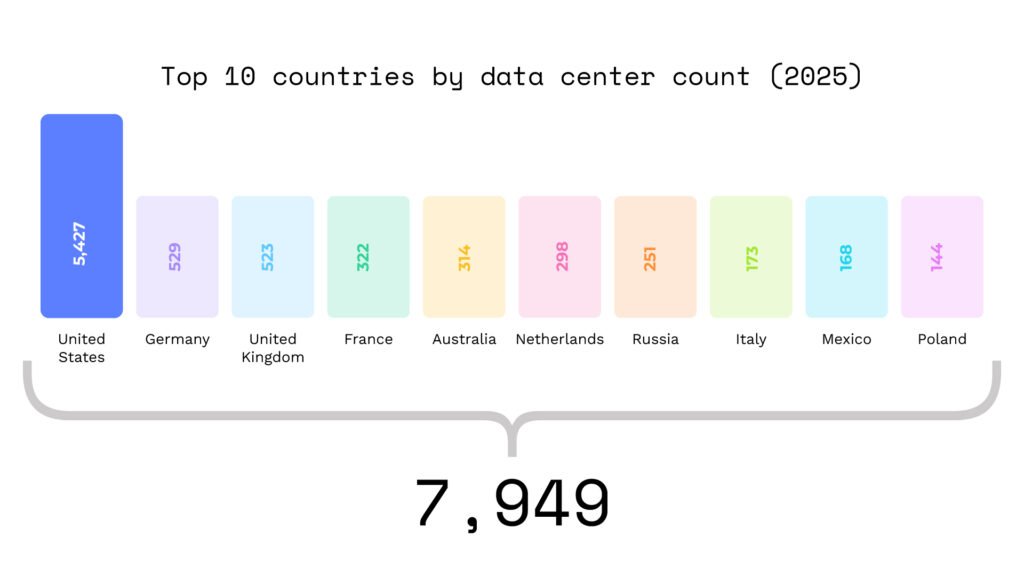
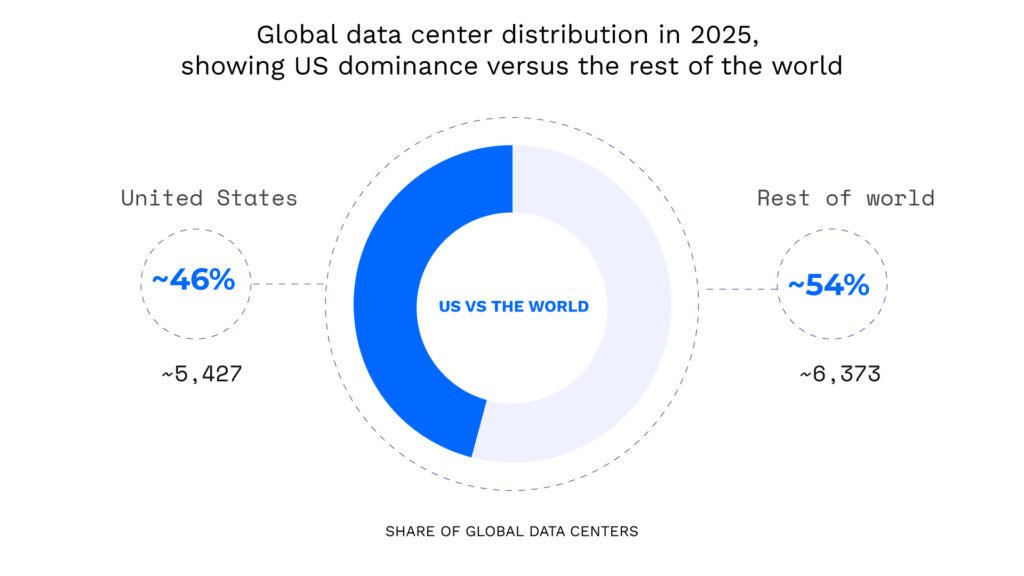
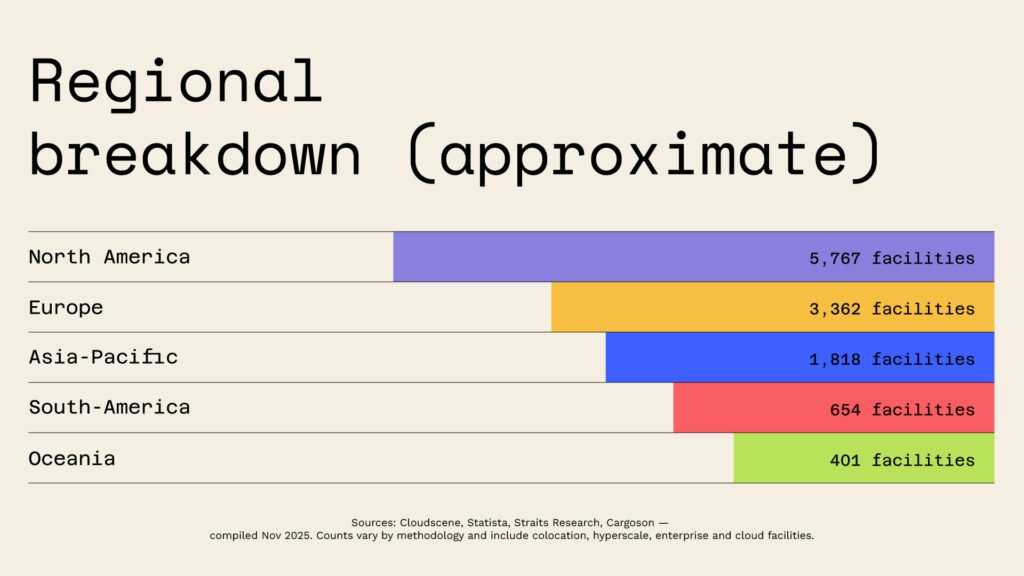
Out of approx. 6421 data centers across the Western Hemisphere, which is 54% of the global data center count, 5,427 (84%) are within the US itself.
For the state of Louisiana to offer up its soybean farmland, along with billions of dollars in tax breaks and 3 power plants from the local utility, they must be excited to be chosen for this ultimate project.
It’ll boost employment for over 5,000 people, in its construction phase, promising 500 permanent positions afterward. From a business perspective, Meta coming to the state is not short of winning the most sought-after trophy in today’s AI-everything world. And with the Governor of Louisiana thanking Meta for its commitment, this sentiment has turned out to be on point.
B. The Community Response
The data center construction has been gamified to a certain extent. The state governments are all too enthusiastic to be chosen for data center projects- so much so, they’ve been making most decisions at the cost of the local community.
If you look at the bigger picture, the promised benefits are cancelled out by the harrowing realities that the locals have to live through. Especially those residing in close proximity to AI data centers.
That is the other end of the spectrum: the reality.
According to Brockovich’s report, lack of transparency comes out on top.
Several of the data center-related questions went unanswered. And community meetings turned into back-door dealings and NDAs. Several times, there would be a meeting, but residents would notice all the meaningful decisions had already been made.
Whose responsibility is it to make the local community aware of the downsides of living near a data center, i.e.,
1. Data centers are increasingly resource-hungry. They use power equal to over 100,000 homes. And one the size of Meta’s will consume twice as much energy as the entire city of New Orleans does.
The consequence: Rising power bills- with fluctuating supply.
2. Data centers demand a huge proportion of water to cool down the servers. A mid-sized facility drinks up almost 5 million gallons of water every day. Amounting to how much a small city would.
The consequence: Drought or water depletion.
3. With data centers needing a constant power supply, many rely on gas-fired generation and diesel generators. And this happens day-to-day, these instruments release greenhouse gases and continuously pollute the air with pollutants such as fine particulate matter (PM2.5) and nitrogen oxides (NOx).
The consequence: Long-term climate and health risks.
4. The construction process, cooling systems, and generators create disruptive noises- smaller ones create 85 decibels, larger ones reach up to 100 decibels.
The consequence: Sleep disruptions and headaches, leading to low quality of life.
With the local governments facilitating corporate expansion, driven by water extraction and massive land acquisitions, the consequences are actually externalized onto local communities.
As the global demand for data grows, the promises of technical progress (read: profit) will always be valued over ecological precarity. All the while draining local reserves. And eroding the environment from the very core.
This is the crux of arguments made repeatedly by local communities. Who will tell them-
Why is their water brown? Why is there a sudden surge in their electricity bill? Why is the electricity shut off without any notice? Why’s everyone, from children to pets, sicker ever since the data center was built?
These questions are being actively shut down. But it isn’t without its backlash.
If the ‘on-screen’ verdict is that the advantages outweigh the risks, even remotely, the accompanying question is: for whom? And that makes us rethink Magouyrk’s remark. A better life, but in what context? The industry lobbyists will always highlight the benefits, alongside burying the costs of gaining those advantages.
The perspectives diverge.
Is AI Truly Worth the Price We’ll End Up Paying?
Yes, AI data centers can create job opportunities, and the tech itself can be leveraged to solve much more complex problems. Especially ones that reel back to how the ecological order can be reinstated- maybe through improved water systems and power grids.
But beyond such use cases, there’s a spotlight on consumers’ role in aggravating superfluous AI use. Imagine thousands of minutes-long AI-generated videos.
MIT has done the math for you. A five-second-long video eats up as much electricity as a microwave running nonstop for an hour. And according to their review, this isn’t how it has already been in the tech domain.
Data centers existed before, but the overall resource usage remained the same, owing to increases in efficiency. But since 2017, everything has gone downhill. The only variable here? Artificial intelligence.
Sustainable solutions, as is being observed, don’t really exist- at least not for data centers as large as Meta’s. Until then, these AI data centers will continue to leverage carbon-intensive energy sources while producing clouds of emissions not even the hopeful technologists will take accountability for.
Policing individual behavior and bigger climate offenders misses the entire point of the conversation. And the rallying cry of environmental groups. You’re taking a stand, not against AI, but for a sustainable progression towards a high-tech future.
Because artificial intelligence, suffice to say, is inevitable- and so are AI data centers for now. And it’s up to those in charge to reweigh the risks and reshape resource-specific needs to build a sustainable AI-first future.
And that starts with transparency.