
GTM teams set goals all the time. Most of them are either too vague to act on or too narrow to mean anything. SMART goals are not a framework to follow rigidly. They are a forcing function that reveals whether you actually understand your motion, your buyer, and your organization’s capacity. Here is what that looks like in practice.
Every GTM team has goals. The question is whether those goals are doing any work.
There is a version of goal-setting that happens in planning cycles that looks productive and produces almost nothing. Numbers get written down. Slides get built. Leadership reviews them. Everyone nods. Then the quarter begins and the real work happens in a different direction entirely, because the goals were never connected to the actual motion the team was running.
The SMART framework, Specific, Measurable, Achievable, Relevant, and Time-bound, gets taught as a productivity concept. It is actually something more uncomfortable than that. It is a test. And most GTM goals fail it not because teams are unsophisticated, but because passing the test requires a level of organizational clarity that many teams have not yet achieved.
Writing a SMART goal forces you to know three things you might not know: what you are actually trying to produce, whether you can track it honestly, and whether the number is grounded in reality or aspiration. Those three things turn out to be hard.
Why GTM Is the Right Unit of Analysis
Before getting into what SMART goals look like for each function, it is worth being clear about why GTM teams specifically, rather than sales teams or marketing teams in isolation, need a goal-setting framework that connects across them.
Your GTM pieces make this point clearly: GTM is a full-organization strategy. Marketing is not driving it. Sales is not driving it. It is everyone working from the same roadmap toward the same outcome. That means the goals have to connect. A marketing goal that runs in one direction while sales is running in another is not a goal-setting failure. It is a strategy failure.
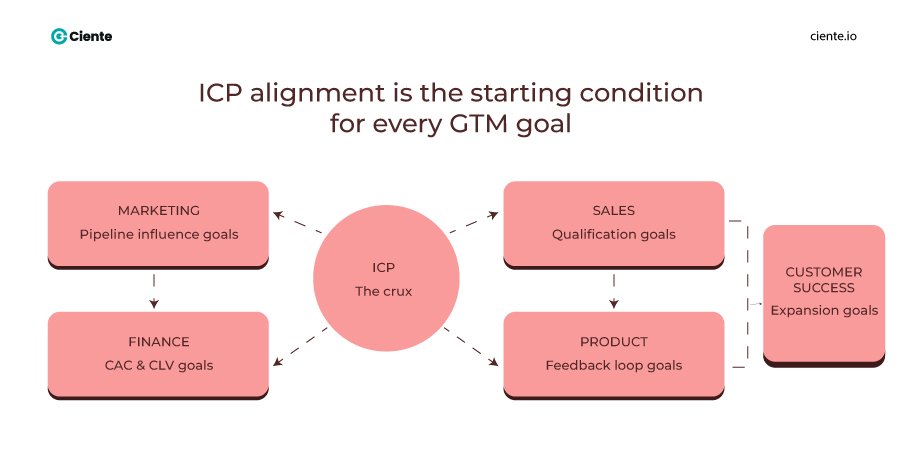
The ICP sits at the center of this. Your checklist treats the ICP as the crux of GTM success, the place where research investment is highest and where every downstream function draws its direction. SMART goals for a GTM team are only meaningful when the ICP is agreed upon, because the goal is always implicitly “produce this outcome with this buyer.” If the buyer is undefined, the goal is undefined, regardless of how precise the number looks.
So the starting condition for any GTM goal-setting exercise is ICP alignment. Not the broad version where everyone agrees the ICP is “mid-market B2B companies in tech.” The specific version where sales and marketing can both name the accounts that qualify and the ones that do not. That clarity is what makes the goals below actionable rather than decorative.
Marketing SMART Goals: From Activity to Influence
Marketing is often where the goal-setting problem shows up first, because marketing has the most metrics available and therefore the most places to hide.
A weak marketing goal looks like this: increase website traffic by 30% this quarter. It is measurable. It might even be achievable. But it is not relevant in the GTM sense unless that traffic has a defined relationship to pipeline. Traffic from the wrong industry, the wrong role, the wrong company size, does not advance the GTM motion. It creates the appearance of momentum.
A SMART marketing goal for a GTM team is organized around pipeline influence, not traffic or MQL volume, especially when you understand how metrics connect across the funnel as explained in sales metrics that matter. Something like: generate 25 net-new opportunities from ICP-fit accounts within the top-down motion by the end of Q3, with marketing touchpoints documented in at least 60% of those opportunities at discovery stage.
That goal is specific about who qualifies. It is measurable if the CRM is set up correctly. It is achievable if the team has mapped the addressable account list. It is relevant because it connects directly to the motion the GTM team is running. And it is time-bound in a way that connects to how long it takes to move an ICP account from first contact to open opportunity.
Notice what is not in that goal: impressions, social engagement, email open rates, whitepaper downloads, which are often mistaken for progress instead of actual pipeline impact as discussed in sales pipeline analysis. Those things might support the goal. They are not the goal.
The other place marketing goal-setting goes wrong is in the content-volume trap, where teams prioritize output instead of impact, a challenge closely tied to content marketing vs sales for SaaS growth. Producing content is not a GTM outcome. Content is a vehicle for communicating the product’s value to the specific segments the GTM motion is targeting. A better goal: develop and distribute buying-committee-specific content for the three primary roles in target accounts, with sales adoption tracked across the next two quarters. This goal creates accountability between marketing and sales. If sales is not using the content, that is a signal. Either the content is wrong or the distribution is broken. Either way, something needs to change.
Sales SMART Goals: Qualification Over Volume
Sales goals in a GTM context have the same problem as marketing goals, but in reverse. Where marketing tends toward vanity, sales tends toward volume. More calls. More demos. More pipeline. The assumption is that enough activity will eventually produce the outcomes.
GTM does not run on enough activity. It runs on the right activity with the right accounts, which is why understanding sales prospecting vs lead generation becomes critical for targeting the right opportunities. And SMART goals for sales have to reflect that distinction.
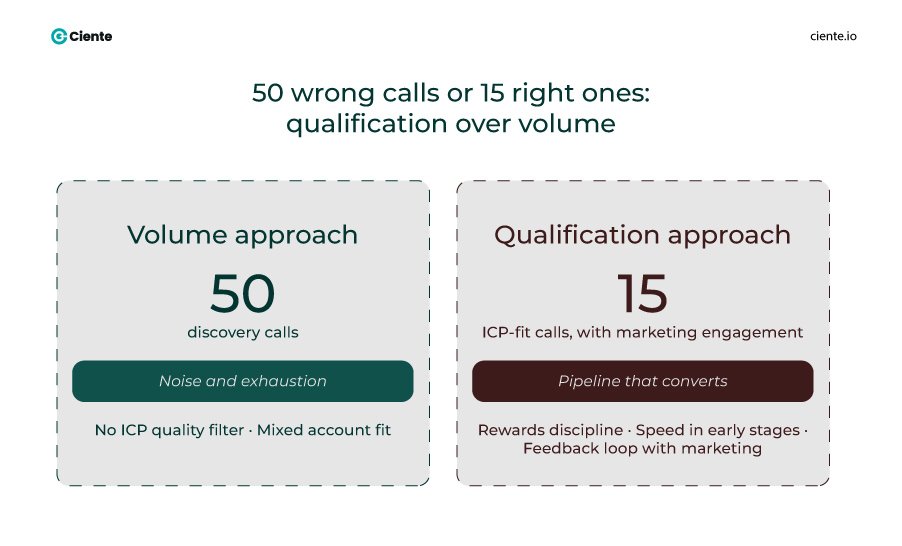
A volume-based sales goal: book 50 discovery calls this quarter, which often ignores the importance of structured qualification as outlined in the 5 step sales process. It is specific and measurable. But it has no quality filter. Fifty calls with accounts that do not match the ICP produce noise and exhaustion. Fifteen calls with accounts that do match it, where marketing has already created awareness and the buying committee has engaged with content, produce pipeline.
A SMART sales goal that fits the GTM motion: convert 40% of ICP-qualified opportunities into second-stage meetings within 14 days of opportunity creation, across the top-down accounts in the current target account list.
That goal rewards qualification over volume. It rewards speed and discipline in the early stages of the sales cycle. It is measurable without being gameable. And it creates a feedback loop with marketing: if opportunities are not converting at that rate, the team needs to understand whether the qualification is off, the messaging is wrong, or the account is not ready.
The other sales goal worth building explicitly in a GTM context is expansion, which becomes more effective when supported by strong account strategies like multi threading in sales. Your GTM strategy pieces acknowledge that the buyer relationship is long-term, and that sales acts as a consultant, not just a closer. Customer expansion does not happen by accident. It happens because someone in the sales team has a structured plan to deepen the relationship after the initial close.
A SMART expansion goal: identify two expansion opportunities within accounts closed in the prior two quarters, with a documented account plan and at least one executive-level conversation per account before end of Q2. That goal is specific, creates accountability for relationship-building, and is relevant to the GTM team’s broader growth motion rather than just the new logo pipeline.
Product SMART Goals: The Feedback Loop That Most Teams Break
Your GTM writing treats product as the true driver of long-term strategy. That is right, and it creates a specific responsibility for product teams in the GTM motion: the feedback loop.
The field is telling product teams things every day, and capturing these insights effectively often depends on systems highlighted in sales enablement platforms. Sales conversations reveal how buyers frame the problem the product is supposed to solve. Customer success conversations reveal where the product falls short of what was promised. These signals are the most valuable market research a product team can access, and in most organizations they stay in silos.
A SMART goal that directly addresses this: establish a documented feedback process between sales and product within 60 days, with monthly structured reviews of the top five objections encountered in sales conversations, resulting in at least two product positioning adjustments or roadmap inputs per quarter.
That goal is specific enough to change behavior. It is measurable through the review cadence and the documented outputs. It is achievable because the data already exists in the CRM and in sales call recordings. It is relevant because messaging that is not grounded in what the product actually does, and what the buyer actually believes about their problem, is messaging that will lose deals. And it is time-bound in a way that creates urgency without being unrealistic.
The broader point is that product goals in a GTM context are not just about feature delivery. They are about closing the loop between what the market is saying and what the product team is building toward. A GTM motion that does not have that loop operating will drift. The messaging will outpace the product, or the product will evolve in a direction the market was not asking for. Either failure is a GTM failure, and it starts with product goals that are not relevant to what sales and marketing are encountering.
Customer Success SMART Goals: Protecting the Foundation
GTM does not end at the initial sale. Your writing on this is direct: customer lifetime value is a KPI that customer success, finance, and marketing must all share ownership of. That means customer success goals cannot live in isolation from the GTM motion.
The most common mistake in customer success goal-setting is optimizing for renewals at the expense of expansion signals, instead of balancing both as part of a broader sales and marketing alignment. Renewals matter. But a customer who renews without growing is a customer who has not yet seen enough value to want more. And a customer who churns is a signal that the GTM motion failed somewhere: in the ICP definition, in the sales qualification, in the onboarding, or in the ongoing relationship.
A SMART customer success goal organized around the GTM motion: reduce churn in accounts acquired through the GTM launch by tracking engagement and intervention early, targeting a 90-day active adoption rate of 80% across the new account cohort.
That goal is specific to the accounts the GTM motion produced. It is measurable if onboarding and product usage data is tracked. It connects adoption to the broader GTM outcome: the product has to do what the GTM motion promised it would do, or the motion is undermined. And it is time-bound to the critical window where churn risk is highest.
The expansion piece of customer success goals deserves its own attention. A SMART goal for expansion: identify three expansion-ready accounts per quarter based on usage data and stakeholder relationship depth, with a formal handoff to sales that includes documented value realization and an account plan for the upsell conversation.
Notice that this goal creates a handoff with sales. Customer success knows when expansion is possible. Sales knows how to have the commercial conversation. The goal creates the bridge between them rather than leaving it to chance or goodwill.
Finance SMART Goals: Making the Math Honest
Finance is involved in GTM for a reason that your writing captures precisely: every campaign, every ad, every piece of content should be seen through a fiscal lens. GTM hinges on whether the money going in is producing outcomes worth the cost.
Most finance goals in a GTM context are lagging: revenue, margin, CAC, which is why tracking leading indicators through approaches like sales analysis to amplify ROI cycle becomes important. These matter. But they tell you what happened, not what is about to happen. The SMART goals that are most useful in a GTM context are the ones that create leading indicators of financial health.
A SMART finance goal: track and report CAC by acquisition channel on a monthly basis, with a defined threshold above which the channel is flagged for review by the GTM team before the next quarter’s planning cycle.
This goal does something important: it creates a governance mechanism. If one channel is producing customers at three times the cost of another, the GTM team needs to know that before it allocates the next quarter’s budget. Finance’s role is not just to count what was spent. It is to make the connection between spend and outcome visible enough that decisions can be made while there is still time to make them.
The other finance goal worth building explicitly: establish a CLV model for the top three ICP segments within the current quarter, so that marketing and sales have a consistent basis for prioritizing accounts by expected lifetime value rather than just by deal size.
That goal is practical and is missing in most GTM processes. Teams prioritize the largest deals because large deals feel like GTM success. But a smaller deal in a high-CLV segment may be worth more to the organization than a large one-time deal in a segment that churns quickly. Finance is the function best positioned to make that argument, and this goal creates the infrastructure for it.
The Goal That Ties All of Them Together
Every function in a GTM team can have well-crafted SMART goals and still fail if those goals are not connected to each other, reinforcing the need for why align sales marketing strategies.
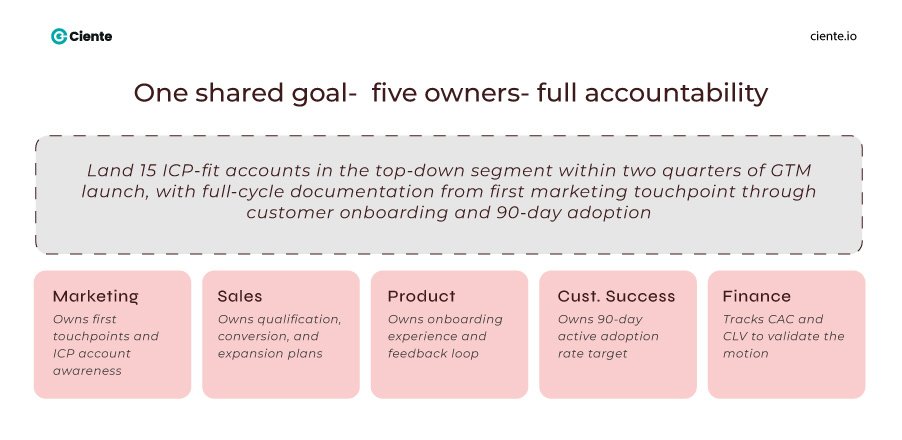
The connecting goal is the one the GTM team sets collectively, before the individual functions set theirs. Something like: land 15 ICP-fit accounts in the top-down segment within two quarters of the GTM launch, with full-cycle documentation from first marketing touchpoint through customer onboarding and 90-day adoption.
That goal belongs to everyone. Marketing is accountable for the first touchpoints. Sales is accountable for the qualification and conversion. Product is accountable for the onboarding experience. Customer success is accountable for the 90-day adoption rate. Finance is accountable for tracking whether the CAC and CLV of those 15 accounts validates the motion.
This is what your GTM writing describes when it talks about cross-departmental collaboration being necessary for success, not as a nice-to-have but as the mechanism through which GTM actually works. The shared goal creates the shared accountability. The individual SMART goals create the specific behaviors that add up to it.
Without the connecting goal, SMART goals become departmental targets that each team optimizes for individually. Marketing hits its MQL number. Sales hits its call number. Product ships its features. Customer success hits its renewal rate. And the GTM motion still underperforms because nobody was accountable for how the pieces fit together.
That is the actual point of SMART goals in a GTM context. Not precision for its own sake. Precision in service of a shared direction that every team can trace their work back to. When that connection is visible, the framework earns its place. When it is not, you are just writing numbers in a document.