
Most reps treat discovery as a form they have to fill out before the real selling starts. The best discovery calls do not feel like discovery at all. They feel like the most useful conversation the buyer had that week.
There is a version of discovery that most sales teams run. It goes like this: open with rapport, ask about current state, ask about desired state, ask who else is involved, ask about budget, ask about timeline, summarize back, book the next meeting.
The buyer has been through this exact sequence enough times that they can feel the framework running underneath it. They answer the questions because they are polite. They share what they planned to share before the call started. They hang up and nothing has changed in how they think about the problem.
That is not discovery. That is a questionnaire with better eye contact.
What Discovery Is Actually For
The point of a discovery call is not to qualify the account. Qualification is a byproduct.The point of a discovery call is not to qualify the account or simply generate sales-qualified leads.The point of a discovery call is not to qualify the account. Qualification is a byproduct.
The actual point is to understand the problem better than the buyer has articulated it to anyone, including themselves. That sounds ambitious. It is. And it is also where every meaningful sale begins.
Buyers walk into discovery calls with a surface version of their problem. It is the version they wrote in the brief, the one they told their manager, the one that made it into the internal project proposal. It is real, but it is not complete. It is the problem as they have been able to frame it given their current understanding of the situation.
The rep’s job is to help them get to the layer underneath.
Not by being clever. Not by asking gotcha questions that reveal the buyer’s blind spots in a way that makes them feel exposed. By listening carefully enough to notice what the buyer is circling around, what they keep returning to, what they say with slightly more energy than everything else, and following that thread until it leads somewhere the buyer had not yet been.
Carl Rogers spent a career explaining that most people have never been fully heard. That when someone listens without agenda, without preparing their next line, without filtering what they hear through what they need from the conversation, the person speaking often discovers things about their own situation they did not know they knew.
Discovery calls are the business application of that principle. And most reps have been trained to skip it entirely.
Discovery Call: The Research Phase That Most People Skip
A perfect discovery call is ninety percent prepared before it starts, much like how strong preparation defines success in any outbound sales playbook.
Not scripted. Prepared. There is a difference.
Scripted means you know what you are going to say. Prepared means you know enough about the account, the industry, the buyer’s role, and the likely shape of their problem that you can ask real questions instead of generic ones.
Before the call: read everything publicly available about the company and use insights similar to those leveraged in sales data analytics. Their recent announcements, their job postings, their earnings calls if they are public, their competitive positioning. Job postings in particular are underrated intelligence. A company posting aggressively for data engineers while their marketing team shrinks is telling you something specific about where their priorities are shifting. That is not information the buyer will volunteer. It is context that shapes every question you ask.
Know the buyer’s title and think through what that role is actually responsible for, especially when planning effective sales personalization strategies. Not the generic persona card. What does a VP of Revenue Operations at a mid-market SaaS company in year three of a PE-backed growth plan actually care about this quarter? What is the thing that keeps them accountable? What would a bad Q4 look like for them personally?
Walk in with two or three hypotheses about what the real problem might be, a mindset that aligns closely with strong sales pipeline analysis practices. Not conclusions. Hypotheses. Things you suspect based on what you know that you are going to test by listening, not by asserting.
The prepared rep does not fill the call with their own voice because they come in with genuine questions they actually want answered.
The Hidden Secret behind every discovery Call
Most discovery calls open with small talk about the weather, a comment about being busy, a request to confirm how much time they have.
None of that is wrong. It is just inert.
A better opening establishes immediately that this call is going to be different, much like how strong first touches define success in top-of-the-funnel sales. from the last vendor call they sat through.
One way: come in with an observation. Something specific you noticed about their business that is genuinely relevant to the conversation. Not a compliment. An observation. “I was looking at your job postings before this call and noticed you’re building out your data infrastructure heavily while the product team seems to be consolidating. I’m curious what’s driving that.” That is not a pitch. It is a signal that the rep paid attention before arriving, and it shifts the dynamic of the conversation from the first sentence.
The buyer leans in slightly differently when they realize the person across from them actually knows something about their situation.
The Questions That Open the Conversation
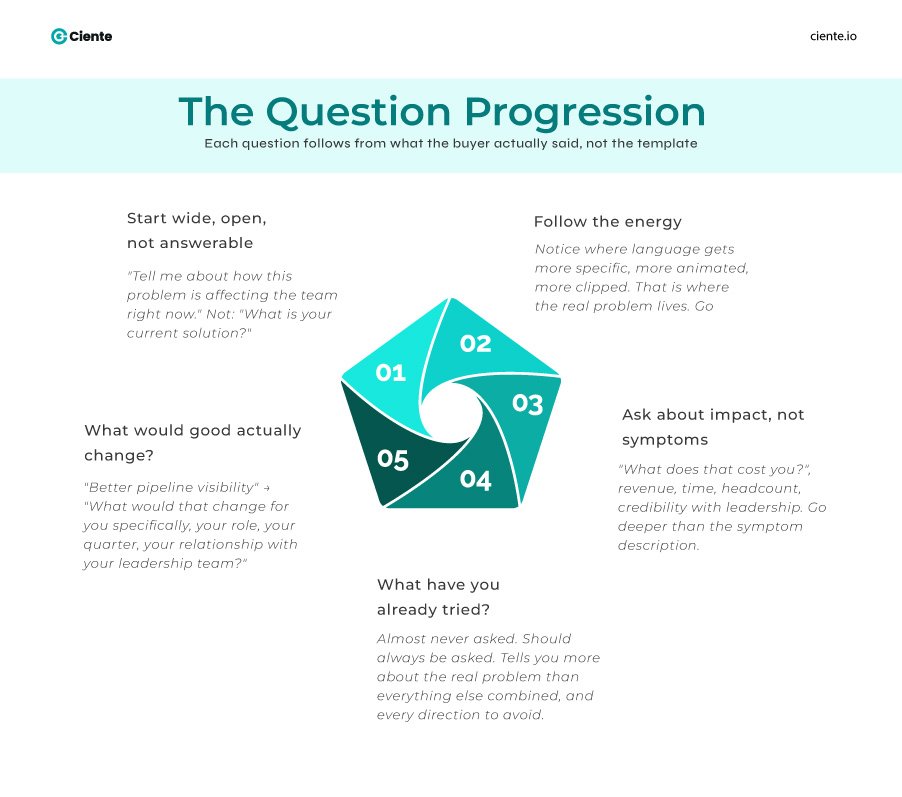
Discovery questions are not a list. They are a progression. Each one should follow from what the buyer actually said, not from what the template said comes next.
The questions that matter most are the ones that move the buyer from what they planned to say to what they have not yet articulated.
Start wide, then follow the energy. Open questions first. Not “what is your current solution?” but “tell me about how this problem is affecting the team right now.” The difference is that the first question has a clean answer. The second one requires the buyer to actually think. Pay attention to where their language gets more specific, more animated, more clipped. That is where the real problem is.
Ask about impact, not just symptoms. especially if you want to tie conversations to measurable sales metrics. When a buyer describes a problem, the instinct is to categorize it and move on. The better move is to go deeper. “What does that cost you?” means revenue, time, headcount, credibility with leadership, whatever it costs. People do not buy solutions to abstract problems. They buy relief from specific, felt pain. You cannot speak to the felt pain if you stop at the symptom.
Ask about what they have already tried. a crucial step often overlooked in structured sales prospecting approaches. This question is almost never asked. It should always be asked. What a buyer has already tried and why it did not work tells you more about the actual problem than anything they have said so far. It also tells you every wrong direction to avoid taking the conversation.
Ask what a good outcome looks like, then ask what that would mean. Most buyers answer the first question in the abstract. “Better visibility into the pipeline.” “Faster reporting cycles.” “A single source of truth.” Ask what that would actually change. For them specifically. Not for the business in the abstract but for them, their role, their quarter, their relationship with their leadership team. The answer to that question is the real buying motivation. Everything else is the path to it.
The Listening That Changes the Call
There is a moment in most discovery calls where the buyer says something the rep was not expecting, which becomes critical in complex deals involving multi-threading in sales.
It usually comes about fifteen minutes in, when the buyer has relaxed slightly and the scripted part of their answer has run out and they start talking about what is actually going on.
Most reps miss it because they are already thinking about the next question on the list.
The moment sounds like this: the buyer is explaining their current process and then says something slightly off the main thread. A comment about the team being stretched. A mention that they tried to address this last year but it stalled. An observation about a shift in how leadership is prioritizing things. A sentence that starts “the real issue is…” before they course-correct back to the official version.
That is the moment. That is the thing the buyer has not fully articulated to anyone yet.
The rep who catches it does not let it pass. They slow down. They say: “you said the real issue is, I want to make sure I understood that. Say more about that.” Not a pivot. Not a segue into the pitch. Just an invitation to continue.
What usually comes next is the clearest version of the real problem the buyer has said out loud yet. Sometimes they surprise themselves by saying it. They will occasionally pause and acknowledge that they have not put it quite that way before. That moment is the call. Everything else is administrative.
What To Do With Silence
Silence in a discovery call makes most reps uncomfortable enough to fill it, especially those trained in rigid sales cadence structures.
Do not fill it.
When a buyer finishes answering a question and goes quiet, they are usually still thinking. The thought that comes after the silence is almost always more honest than the one that came before it. It is the answer after the prepared answer. Give it room.
The same applies when you ask a question that genuinely makes the buyer think. If they pause, they are working through something. That pause is valuable. Interrupting it with a rephrasing of the question or a clarification robs the call of whatever was about to surface.
The Trap Every Prepared Rep Falls Into
is similar to challenges seen in scaling modern sales enablement strategies. Knowing a lot about an account before the call creates one specific failure mode: the rep starts confirming their hypotheses instead of listening for what is actually true.
They asked a question about X because they suspected X was the problem. The buyer gave a partial answer about X. The rep moved on because X was confirmed. But the buyer was also trying to say something about Y that they did not quite get to because the question was already moving elsewhere.
Preparation creates hypotheses. Listening either confirms or corrects them. The rep who walks in prepared and then listens as if they know nothing has done both things correctly. The rep who walks in prepared and then runs the hypotheses as a checklist has used their preparation against themselves.
The question to hold throughout the call: what is this buyer telling me that I did not already know?
Closing the Discovery Call
effectively plays a key role in moving deals through the sales pipeline. Most reps end discovery by summarizing what they heard and proposing a next step. That is the minimum.
The version that converts better does something additional: it reflects back the shape of the problem in a way the buyer has not heard before.
Not a pitch. Not a solution. A reframing.
“From what you’ve described, it sounds like the issue isn’t just the tool — it’s that the team doesn’t have a shared definition of what good looks like, so even when the data is available, there’s no agreement on what to do with it. Is that close to what you’re experiencing?”
If it lands, the buyer will say yes with more energy than anything they said during the call. Because you have named something they were feeling but had not organized into a sentence. That is the moment they decide whether this rep is worth continuing the conversation with.
The discovery call is not the place to impress the buyer with what you know about your product, but rather to support broader b2b sales strategies that focus on understanding. It is the place to impress them with what you understand about their problem.