
The quick sale has always been a false promise, a vision forced upon others. Consultative selling might be a solution or the worst thing ever. It’s your call to choose.
As Tyler Durden says, “Advertising has us chasing cars and clothes, working jobs we hate so we can buy shit we don’t need.”
While quoting Fight Club can seem like the start of a satirical critique on the nature of selling, it is not that.
None can escape the hamster wheel of consumerism; everyone wants to survive, eat well, and live luxurious lives, including work lives. But what we can eliminate here is the forced sell; the tranquilizer to modern life can be transformed into a genuine promise.
Not a lullaby to lull your buyers into a false sense of security, but rather a consultative approach to corporate (B2B?) growth.
Consultative Selling is not altruistic
Let’s get something out of the way before this becomes a hopecore piece- consultative selling is not altruism, though that can be a good byproduct of it, an amazing marketing tactic.
Because if you help your buyer find the right fit for them, they will recommend you to others in similar buying scenarios.
So then what is consultative selling?
It’s a simple calculus- buyers feel that B2B is transactional- devoid of feeling and empathy. Thus, the consultative vs solution selling approach adds real problem-solving and the ability to understand what buyers might be facing on multiple levels.
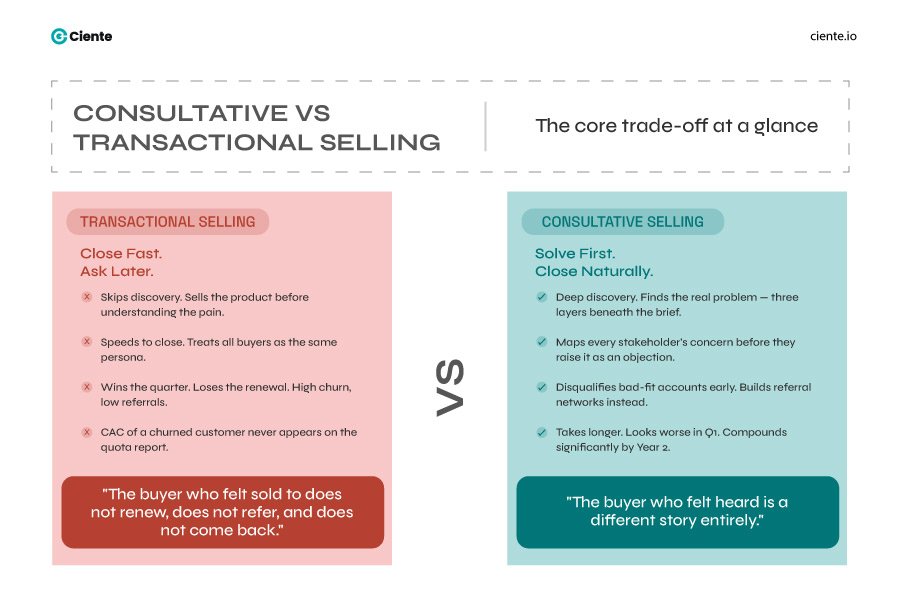
Consultative selling, when done properly, is the approach to maximizing sales by understanding buyers’ core needs and problems, then guiding them to make the right choice—much like a structured lead qualification process ensures you’re solving for the right customer from the start. This has a major consultative selling advantage over other forms of selling-
- It provides you with buyer objections and requirements
- It gives your marketing team data to work with by finding out what the buyers are asking and why.
- It helps teams brainstorm new ways of approaching the buyers, equipped with a deeper understanding of their needs. especially when aligned with target account selling approaches.
But there is also a huge drawback – you might miss the sale. There is a good chance that you realize that your solution might not be ideal for the buyer and, you might have to reroute them to a better solution.
That is where consultative selling is going to lose a majority of leaders who must fill the pipeline.
The Multi-layered Sale
Here is where consultative selling stops being a philosophy and starts being a skill problem.
A B2B deal rarely has one buyer. It has a buying committee. something that becomes even more critical when comparing ABM vs lead generation strategies. Eight to eleven people, on average, each with a different relationship to the problem your product solves, a different definition of success, and a different reason to say no.
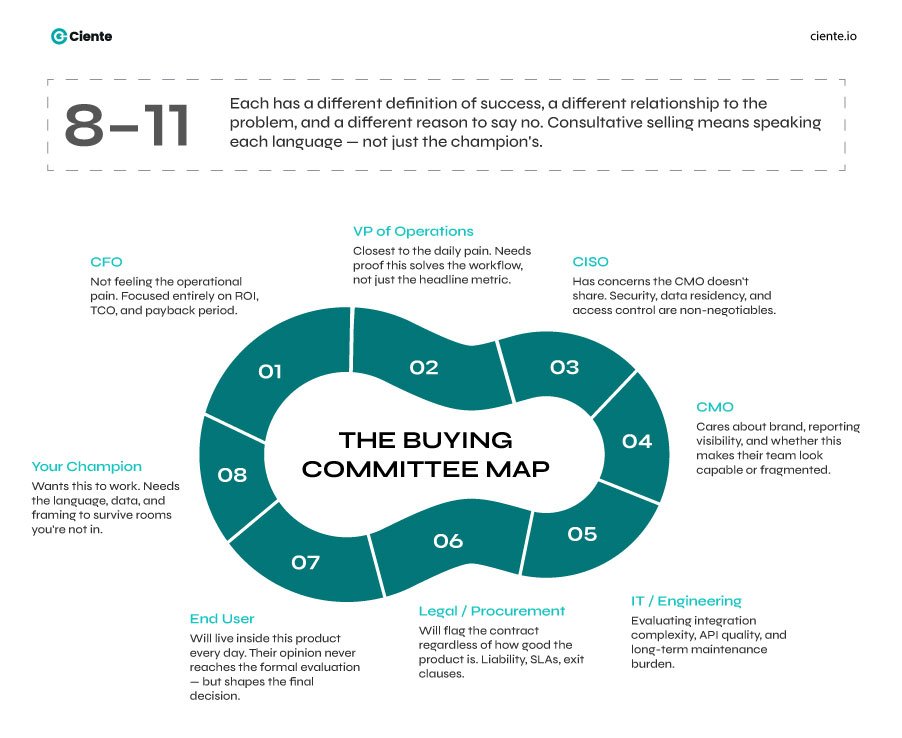
The CFO is not feeling the pain the VP of Operations is feeling. The CISO has concerns the CMO does not share. The end user who will live inside your product every day has opinions that never make it into the formal evaluation process but absolutely influence the final decision.
Consultative selling in a multi-stakeholder environment means you are not solving one problem, but engaging across personas much like personalized enterprise selling strategies demand. You are mapping an organization’s problem across every layer it exists in and speaking to each layer in its own language.
This is not as complicated as it sounds, but it requires one thing most reps skip: genuine curiosity about how the organization actually works, not just where the budget sits.
Start with the problem behind the problem. When a buyer says they need a better reporting solution, that is rarely the real problem. The real problem is that someone senior is asking questions the current system cannot answer and someone is getting embarrassed in a meeting. Find that. The solution sells itself once you are speaking to the actual pain rather than the symptom they led with.
Map the objections before they surface. using insights similar to those derived from lead scoring models. Every stakeholder in a buying committee has a version of the objection they will eventually raise. The CFO will ask about ROI and total cost of ownership. The IT team will ask about integration and security. The legal team will flag the contract. A consultative rep does not wait for these to arrive. They surface them early, address them on their own terms, and reframe them before they become blockers.
Give each stakeholder something to champion internally. The deal you are working through a champion still has to survive the rooms you are not in. Give your champion the language, the data, and the framing to represent the solution accurately to each person on the committee. A rep who only sells to the champion and hopes they will carry the message is leaving the outcome to chance.
The Objection You Have to Be Honest About
Consultative selling takes longer. There is no getting around it.
The transactional approach is faster on the surface because it skips the hard conversations. often leading to issues highlighted in why businesses stop losing leads too late. It skips the moment where you realize the buyer might not be the right fit. It skips the discovery that reveals the real problem is three layers deeper than the one in the brief. It closes faster, and it churns faster, and the CAC of winning back a churned customer or repairing a referral network damaged by a bad fit sale never appears on the rep’s quota report.
The math on consultative selling looks worse in the short term. but aligns better with long-term value seen in customer experience and lead nurturing alignment. It looks significantly better over any meaningful time horizon.
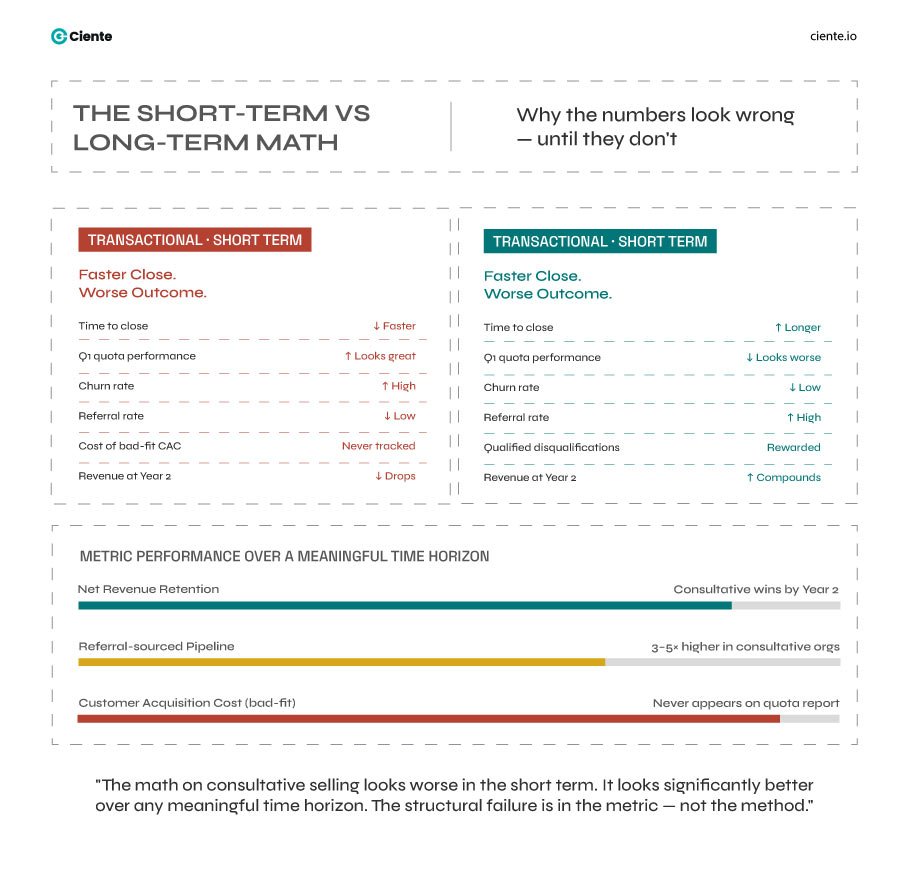
But here is the honest concession: if your pipeline is thin, if the quarter is ending and the number is not there, the consultative approach becomes very difficult to justify to leadership that is looking at a dashboard and not a relationship.
This is not a character failure. It is a structural one. Organizations that reward quarterly closes and ignore lifetime value are building the exact incentive that produces transactional selling, regardless of what the sales training deck says.
If you want consultative selling to work, the metrics around it have to reflect the behavior it requires. That means measuring deal quality alongside deal volume. It means tracking referral rates from closed accounts. It means giving reps credit for the qualified disqualification, the account they walked away from because it was not the right fit, instead of punishing them for a low close rate on bad-fit opportunities.
Without that, consultative selling is something the company says it does and the reps do when the quarter is comfortable.
What Actionable Actually Looks Like for Consultative Selling
Before the first call, know what success looks like for this specific buyer at this specific moment. Not the generic persona. The actual company, the actual initiative, the actual pressure they are operating under. Their recent earnings call, their job postings, their leadership changes. The consultative rep arrives informed, not scripted.
Ask the question behind the question. When a buyer raises a concern, the instinct is to answer it. The better move is to understand it first. “What’s driving that concern?” gets you further than a prepared rebuttal. Most objections are not about what they appear to be about.
Make the disqualification explicit when it is the right call. If the solution is not the right fit, say so clearly and early. Offer them a direction toward what is. This feels like losing the deal. It is actually building a referral source, a market reputation, and occasionally the exact condition that brings that buyer back two years later when their situation changes.
Use your data as a consultative asset, not just a closing tool. similar to how lead tracking systems provide actionable intelligence. Marketing data on what buyers in similar roles are searching for, what content they are consuming, and what objections are appearing most frequently across accounts is intelligence the buyer does not have about their own market. Sharing it, in context, in a way that is useful to their decision-making rather than just favorable to yours, is what makes the conversation feel different from every other vendor conversation they sat through that week.
Follow up on the outcome, not the sale. After a deal closes, the consultative rep asks whether it is working. Not because they are required to by a customer success process, but because they told the buyer this would solve a specific problem and they want to know if it did. That behavior, more than any pitch, is what gets someone to pick up the phone the next time you call.
The quick sale has always been a false promise.
Not because it is immoral, but because it is inefficient. The buyer who felt sold to does not renew, does not refer, and does not come back.
The buyer who felt heard is a different story entirely.