ABM is not a campaign. It is not a tactic. It is a strategy that requires patience, personalization, and the willingness to engage people who have not asked to hear from you yet. Most SaaS teams are doing a pale imitation of it and wondering why nothing closes.
Everyone has heard the ABM success stories.
Pipeline quality goes up. Sales cycles shorten. The right accounts start responding. The whole go-to-market motion starts feeling less like shouting into a void and more like a real conversation.
So teams invest in it. Buy the intent tools. Build the account lists. Set up the personalized sequences. Run the targeted ads as part of their broader SaaS marketing playbook.
And then nothing happens.
The pipeline does not improve. The accounts stay quiet. The dashboard looks busy and the revenue does not move.
And the conclusion most teams reach is that ABM does not work for them, even though it is often a matter of misalignment with core B2B SaaS marketing principles.
That conclusion is wrong. ABM works. The version of ABM most SaaS teams are running does not.
What ABM Actually Is
Not a Campaign. A Hunt.
This framing matters more than it sounds.
A campaign has a start date and an end date. It has deliverables. It runs, it reports, it concludes. You measure it and move on.
ABM does not work like that.
ABM is a hunt. And a hunt requires patience, preparation, and the understanding that you are after something that is not waiting to be caught. Something that has its own agenda, its own committee, its own shortlist of options it is already considering.
You are not running a campaign at an account. You are engineering a slow, deliberate shift in how a specific group of people inside a specific organization thinks about their problem and the options available to solve it.
That takes time. More time than most SaaS marketing teams have been told to expect. More time than a quarterly plan accounts for. And far more specificity than any packaged ABM playbook will give you.
Why do ABM campaigns seem to fail?
Here is why most ABM fails before it even starts.
The accounts you are targeting already have a shortlist, something many teams only recognize after analyzing competitor positioning through SaaS competitor marketing research.
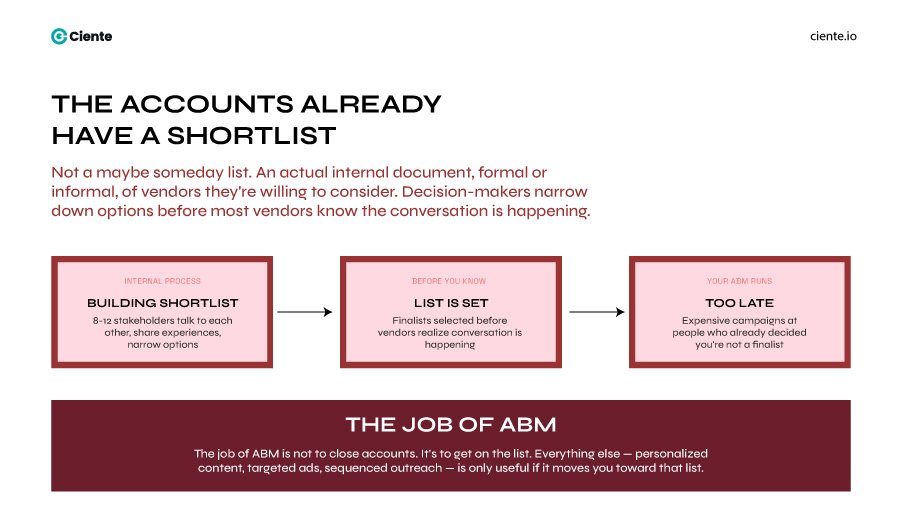
Not a maybe someday list. An actual internal document, formal or informal, of vendors they are willing to consider. Decision-makers inside a buying committee talk to each other. They share experiences. They have vested interests and collective goals. And they narrow down their options before most vendors even know the conversation is happening.
The job of ABM is not to close accounts. It is to get on the list, a goal closely tied to strong lead generation for SaaS programs that build early account awareness.
Everything else, the personalized content, the targeted ads, the carefully sequenced outreach, is only useful if it moves you toward that list. If you are not thinking about ABM in those terms, you are running expensive campaigns at people who have already decided you are not one of the finalists.
That is the gap. And it is enormous.
Why SaaS ABM Keeps Getting Watered Down
There is no shortage of ABM content, much like the abundance of guidance across broader SaaS marketing insights available to growth teams.
Playbooks. Frameworks. Step-by-step guides. All of them technically accurate and almost entirely insufficient.
Because the nuance that makes ABM actually work cannot be packaged into a process. It lives in the specificity of the account, the composition of the buying committee, the internal politics of who has influence and who has budget authority, and the precise moment when the problem your product solves becomes urgent enough to act on.
None of that is in a playbook.
What is in a playbook is the skeleton. The bare structure. Identify accounts. Find intent signals. Personalize outreach. Engage stakeholders. That is all true. It is also about thirty percent of what you actually need to know.
The other seventy percent is judgment. Reading a specific account. Understanding what each stakeholder inside it actually cares about. Knowing the difference between a visitor who is doing research and a group of people from the same organization showing up in the same places, which is a signal worth paying serious attention to.
That judgment does not come from a guide. It comes from doing the work.
ABM fails in SaaS for one consistent reason that nobody wants to say out loud.
Teams build a plan and then execute the plan regardless of what they are learning.
The account signals something. A stakeholder engages with something unexpected. The intent data shifts. The champion stops responding.
And the plan keeps running. Because the plan was approved. Because changing it mid-flight feels like failure. Because the quarterly report needs to show that the ABM program ran as scoped.
ABM does not reward rigidity. It punishes it.
The whole premise is that you are engaging a group of human beings with individual interests who are collectively navigating a decision. Human beings do not behave on schedule. The account does not follow your campaign calendar, which is why rigid campaign structures often struggle within traditional SaaS marketing funnels.
What works is the ability to read what is happening and adjust. To treat the plan as a starting point rather than a contract. To be willing to change the message, the channel, the sequencing, the stakeholder priority, based on what you are actually observing.
That flexibility is not chaos. It is responsiveness. And responsiveness is what separates ABM programs that close accounts from ones that generate activity reports.
The Multi-Stakeholder Reality in Account Based Campaigns
You Are Not Selling to an Account. You Are Selling to a Committee.
This is the part most SaaS marketing misses entirely.
When you target an enterprise account, you are not targeting a company but a complex group of stakeholders, which makes strong B2B SaaS customer segmentation critical. You are targeting somewhere between eight and twelve people who have different jobs, different priorities, different fears, and different definitions of success.
The CSO wants security and integration. The CTO wants clean data and minimal engineering overhead. The CFO wants to know what the ROI looks like and when it materializes. The end users want something that does not make their day harder. The executive sponsor wants something that makes them look smart for bringing it in.
That is five different conversations inside one account. And those five people talk to each other. Which means the conversation you have with one of them affects every other conversation.
Most ABM programs build one message and send it at multiple stakeholders with mild personalization on top, even though modern SaaS content marketing strategies emphasize role-specific messaging. Different name in the subject line. Slightly adjusted copy. The same fundamental pitch.
That is not multi-stakeholder engagement. That is spray and pray with a personalization veneer on it.
Real multi-stakeholder engagement means knowing what each person in the buying committee cares about and meeting them there. Not just in your outreach copy but in your content, your sales conversations, your case studies, your proof points.
How to Find the Buying Committee Without Being Told Who They Are
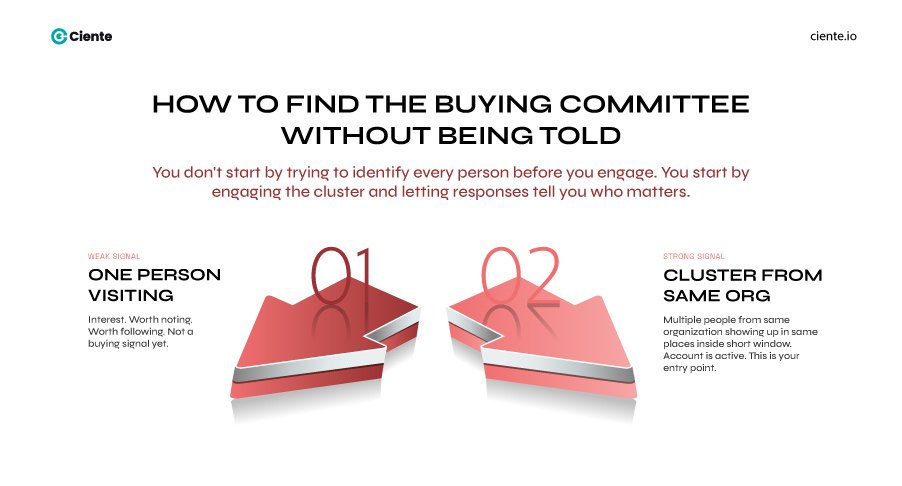
Here is the practical version.
One person visiting your website or engaging with your content is interest and often forms the starting point of broader SaaS inbound marketing engagement patterns. Interesting, worth noting, worth following.
A group of people from the same organization showing up in the same places inside a short window is a signal. That cluster means the account is active. Some of those people are decision-makers. Some are influencers. Some are doing research on behalf of a stakeholder who has not surfaced yet.
That cluster is your entry point.
You do not start by trying to identify every person in the buying committee before you engage. You start by engaging the cluster and letting the responses tell you who matters. Who responds thoughtfully. Who asks the right questions. Who goes quiet in a way that suggests they are bringing your information back to someone else.
The committee reveals itself through engagement if your engagement is worth responding to.
That last part is where the work is.
Personalization In ABM
It Is Understanding What Each Stakeholder Is Actually Trying to Protect
Every person in a B2B buying committee has something at stake, which is why many teams track engagement signals alongside core SaaS marketing lead scoring methods.
Not just professionally. Personally. Their credibility. Their relationships inside the organization. Their track record of making good recommendations. Their ability to avoid being the person who signed off on a bad vendor.
ABM personalization that ignores this is surface level. Swapping a company name and a job title into a template is not personalization. It is mail merge with better tools.
Real personalization is understanding what a specific person in a specific role at a specific organization is trying to achieve and protect. And then building every touchpoint around that.
The CFO at a Series B SaaS company is not the same as the CFO at a legacy enterprise in a regulated industry. They have different pressures, different approval processes, different definitions of risk. The content that moves one will not move the other.
Your ABM program needs to know the difference. And it needs to build different things for each of them, not the same thing with a different header.
The Sales Team Is the Campaign
This is the piece most marketing-led ABM programs leave on the table.
Sales knows things about buyers that no intent tool can surface, insights that often directly influence B2B SaaS marketing ROI when integrated into strategy. They know what objections come up in every call with a specific type of account. They know what language buyers use to describe the problem your product solves. They know which stakeholders in a buying committee are usually the real decision-makers regardless of what the org chart says.
That knowledge is the most valuable input your ABM program has.
And most ABM programs are built without it. Marketing builds the strategy. Creates the content. Selects the accounts. Designs the outreach sequences. And then hands it to sales as a brief.
That is backwards.
Sales should be co-authoring the ABM strategy from the beginning. Because the campaign that marketing runs is only the surface of the engagement. The conversations sales has are where the real work happens. And those conversations need to be extensions of the same strategy, not a separate motion running in parallel.
When marketing and sales are running different versions of the ABM story at the same account, the buying committee notices. They compare notes. And inconsistency erodes the trust that ABM is supposed to be building.
What This Looks Like Differently Across Company Size
SMBs: Fewer Stakeholders, Faster Signal
ABM for SMB accounts moves faster and rewards directness.
There are fewer decision-makers. Often one or two people hold both the budget authority and the product decision. The sales cycle is shorter. The committee is smaller.
The ABM opportunity here is to identify the champion fast and go deep with them. Build the relationship before the account is in active evaluation mode. Be the vendor they already trust when the urgency kicks in.
SMBs do not have the bandwidth for lengthy evaluation processes, which is why efficient SaaS marketing funnels become especially important in smaller sales cycles. They want something that works and someone they believe will not disappear after the contract is signed. Your ABM program needs to communicate both of those things quickly and credibly.
Enterprise: Patience Is the Strategy
Enterprise ABM is a different game entirely and often aligns with broader B2B SaaS market strategy considerations.
The buying committee is larger. The sales cycle is measured in months, sometimes over a year. The decision involves people you will never directly engage with and conversations you will never be part of.
The strategy here is not to close fast. It is to become unavoidable.
Your content is in every relevant conversation, supported by strong thought leadership in SaaS marketing that builds long-term credibility. Your name comes up in every peer recommendation channel. Your case studies are already familiar to the economic buyer before your sales team ever gets a call. Your champion inside the account has everything they need to make the internal case without you in the room.
Enterprise ABM is about building presence over time. Not just awareness. Presence. The kind of presence that means your name is already on the list before the formal evaluation starts.
That takes investment. It takes patience. And it takes the willingness to build for a twelve-month horizon when most marketing programs are measured quarterly.
The Honest Version of What ABM Requires
ABM is not the shortcut it gets sold as.
It is resource-intensive. It demands genuine personalization, not the cosmetic kind. It requires sales and marketing to operate as one function rather than two teams with overlapping goals. It asks you to play a longer game than most SaaS organizations are currently structured to play.
And it only works if you are willing to get specific enough to be uncomfortable.
Not just specific about which accounts you are targeting. Specifically about each person inside those accounts. What they care about. What they are trying to protect. What they need to hear from you to put you on the list.
That specificity is the whole thing.
The teams that treat ABM as a targeting upgrade to their existing demand gen motion will get modest results. The teams that treat it as a complete rethinking of how they engage buyers will get the pipeline quality the case studies talk about.
The difference is not the tools or the budget.
It is the willingness to do the work that makes the work worth doing.