
AI search doesn’t rank you. It either cites you or skips you. Understanding the benefits of answer engine optimization starts with knowing that.
Search behavior has shifted structurally. Users no longer type keywords and scan ten blue links, and this shift is already visible in how marketers track share of search as a signal of brand visibility across digital channels.
They ask specific, contextual, high-intent questions and then expect a direct answer. Google’s AI Overviews, Perplexity, ChatGPT, and Gemini have all moved to meet that expectation. The retrieval logic underneath these systems rewards something different from what traditional SEO can satisfy.
Answer Engine Optimization is the discipline built for this environment.
It’s the practice of structuring content so AI-powered systems can extract, trust, and surface it as a direct response to user queries. The brands investing in it now are not chasing a trend. They’re building positions that become challenging to displace over time.
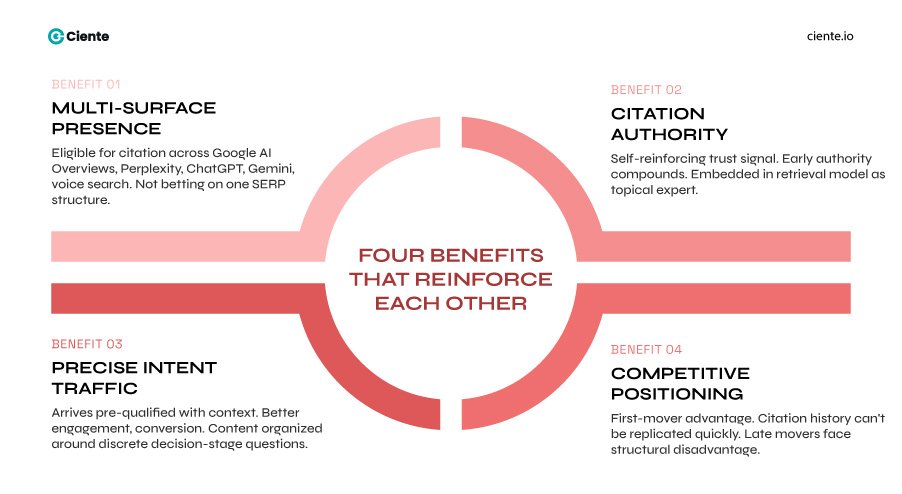
Here’s the why: four distinct, non-overlapping pillars that together cover the full funnel strategic case for what the benefits of AEO are.
Benefit of AEO 1: Multi-Surface Presence, i.e., Organic Reach Beyond the SERP
Traditional SEO optimizes for one surface: the Google search results page. It still matters. However, it’s no longer the whole picture.
How AI Search Surfaces Differ from Google Rankings
A user researching a high-consideration purchase might inquire Google, follow up on Perplexity, ask ChatGPT for a comparison, and use AI-assisted search in their browser- all within a single research session.
These systems leverage different retrieval logic, but they share a common requirement: structured, semantically complete content that answers discrete questions with precision.
AEO-optimized content is built for this retrieval logic, meaning it’s eligible for citation and surfacing across all these environments, a strategy that explains the hidden way to appear in AI answers.
That’s a fundamentally different reach profile than a ranked link.
Why AEO Content Holds Up as Search Surfaces Fragment
The longevity implication here is significant.
Search surfaces will continue to fragment as more AI-native tools embed search functionality. A content strategy built merely for Google rankings is betting that the current SERP structure remains dominant.
Voice Search and the Single-Answer Problem
Voice search adds a layer that makes this even more concrete.
When a user asks their phone a question, they get one answer. That answer comes from somewhere. The brands whose content is structured for precision answering win that placement.
There’s no second position in a spoken response.
Benefit of AEO 2: Citation Authority as A Trust Signal
When an AI system cites your content as the answer to a user’s question, something specific impacts brand perception—especially when the content strategy is tied to a broader lead generation engine that converts visibility into pipeline. The system has evaluated available information and pointed to you as the most reliable source.
That’s a credibility signal that a ranked link doesn’t carry in the same way.
Why Being Cited Builds Brand Trust at the Point of Highest Intent
It matters because AI-generated responses and their citations are trusted by users for complex or high-consideration queries. These are the exact query types where brand trust has the highest commercial value.
Being the cited authority in that context transfers credibility in a way that a tenth-place ranking doesn’t.
The compounding dynamic is worth understanding precisely.
How Citation Patterns Create a Self-Reinforcing Authority Loop
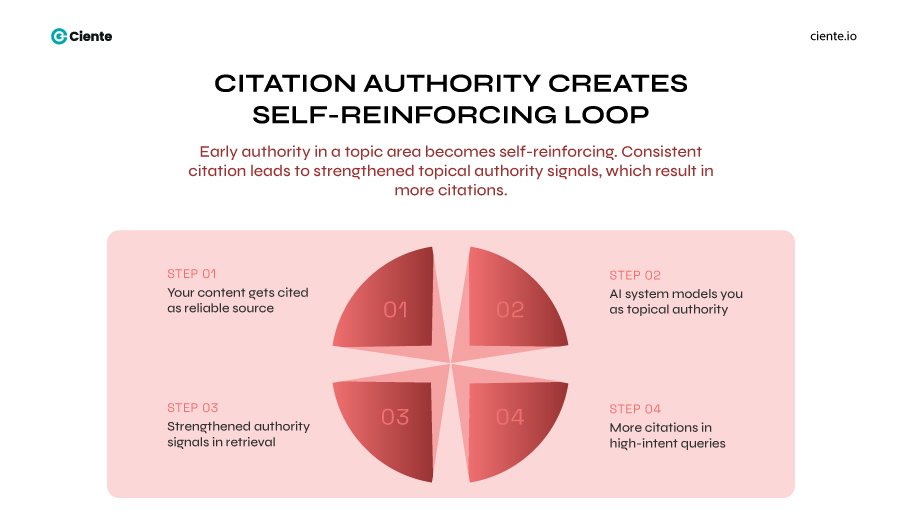
AI systems build a model of which sources are reliable for which topics based on citation patterns, content freshness, and engagement signals. Early authority in a topic area becomes self-reinforcing. And then consistent citation leads to strengthened topical authority signals, which result in more citations.
This feedback loop operates differently from link-based authority, which is slower and more susceptible to competitive erosion.
The implication for brand strategy is that AEO is not just a traffic acquisition tool. It’s a trust-building mechanism that operates at the point of highest user intent.
Brands that establish citation authority in their category are building equity that lives in the retrieval model itself.
However, one condition applies: this compounding only works when the cited content is genuinely expert. AI retrieval systems are progressively better at distinguishing semantic depth from surface-level formatting.
Real expertise, properly structured, builds durable authority. Thin content with a clean HTML structure does not.
Benefit of AEO 3: Precise Intent- Your Audience Traffic Arrives Pre-Qualified
AEO performs best on specific, high-intent queries. The kind where a user knows what problem they’re tackling and wants a precise answer.
This selectivity produces a traffic quality profile that broad SEO strategies don’t replicate.
What Makes AEO-Driven Traffic Convert Differently
When someone arrives via an AI citation, they’ve already received context. The system illustrated that your content is a credible and relevant source for their specific question. They arrive with established framing and a degree of trust that cold organic traffic doesn’t carry.
That’s a different starting condition for the user relationship.
And behavioral metrics reflect this.
AEO-driven traffic tends to portray stronger engagement signals—lower bounce rates on relevant pages, longer time on site, and better conversion rates on high-intent service or product pages, particularly when supported by structured content marketing services.
That has a structural implication for content architecture.
How Intent-First Content Changes Your Architecture
AEO optimization pushes you to organize content around discrete questions your audience asks at specific stages of their decision-making process. That’s a more useful architecture than a library organized around broad topic clusters.
You end up with content that captures intent precisely over casting wide and hoping engagement follows.
The longevity angle: as AI systems develop in understanding query intent, content designed around precise intent matching gets more valuable, not less. Broadly optimized content faces increasing pressure as retrieval systems deprioritize it for high-specificity queries.
Precisely structured, intent-matched content gets more eligible for citation as systems improve.
Benefit of AEO 4: Competitive Positioning
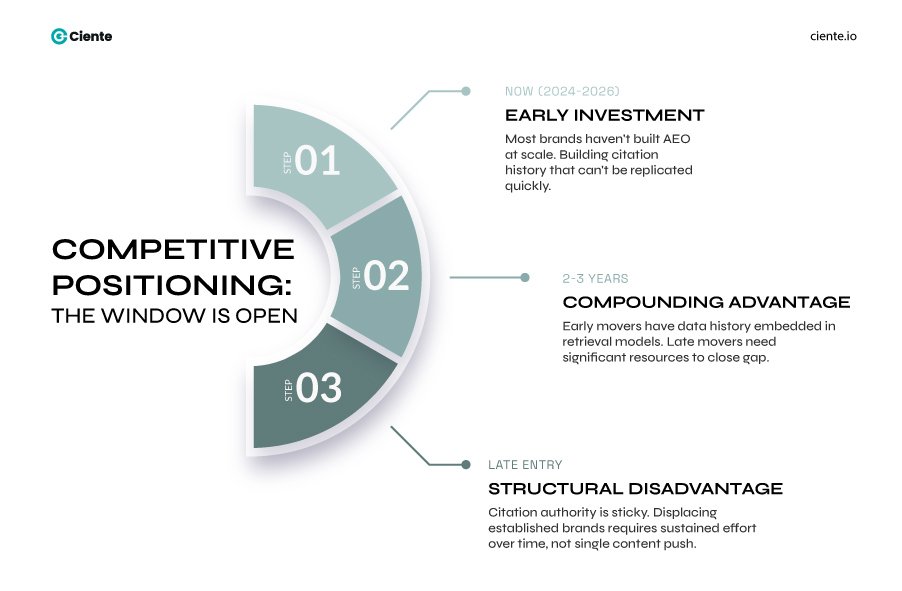
The competitive window for AEO is ajar.
Most brands haven’t built AEO-optimized content at scale. Those investing consistently during this period are building positions that become structurally harder to displace.
How AI Retrieval Systems Model Topical Authority Over Time
The mechanism works like this.
AI retrieval systems develop a model of topical authority over time. It’s based on 3 factors: citation history, content consistency, and domain expertise signals. Once you establish yourself as a cited source in your category, you accumulate a data history that can’t be replicated quickly.
The moat is on a deadline: It favors consistent early investment.
Compare this to keyword rankings. They shift substantially with algorithm updates, competitor content investment, or link-building campaigns.
Citation authority is stickier. It’s embedded in how the retrieval system has modeled expertise in a given area. Displacing a brand that has a consistent citation history in its category requires sustained effort over time, not a single content push.
The Audience Research Byproduct of Running an AEO Systematically
AEO also generates a byproduct that compounds the benefits internally.
Tracking which queries drive AI citations to your content reveals precisely what questions your audience asks in high-intent contexts—insights that also influence brand positioning and branding and design services. This research intelligence drips into product messaging, sales enablement, and content strategy in ways that standard keyword data cannot match.
That has a crucial implication.
The brands running AEO systematically also operate continuous audience research as a function of their content operations.
The implication for timing: this is a first-mover category.
The brands that build citation authority in their topic areas over the next two to three years will have compounding advantages that late movers will need significant resources to close.
Waiting to “see how AI search develops” is in itself a positioning decision. One that cedes ground to whoever doesn’t wait.
The Four Benefits of Answer Engine Optimization Are Distinct, But They’re Not Independent.
Multi-surface presence generates citation opportunities. Citation opportunities build topical authority. Topical authority attracts higher-intent traffic. Higher-intent traffic produces conversion signals that revamp your content strategy and feed directly into scalable lead generation services for long-term pipeline growth.
And all of it happens in a competitive environment where early, consistent movers compound their advantages over time.
AEO is not a channel.
It’s a content infrastructure decision. Brands that treat it as a campaign or a one-time optimization project capture some of the benefits but fail to build their positioning.
The compounding advantage belongs to brands that integrate AEO into their ongoing content operations, i.e., structuring every piece of content around precise intent, genuine expertise, and retrieval eligibility.
The brands doing that now are building something durable. The question is whether yours is one of them.