
Discover why traditional B2B SaaS ROI benchmarks mislead and how context, TAM, and strategic marketing drive sustainable growth and market authority.
In the current software landscape, the CMO role is shifting. We have more data, more AI-powered automation, and more tracking tools than ever before. Yet, organizations are finding that their “good” ROI isn’t translating into sustainable market share.
The reason is simple: marketing has become equated with noise. Silicon Valley has hedged its bets on arbitrary solutions—mass-blasts, cookie-cutter webinars, and deceptive content—that are designed to convert but not to educate. If you want to build a business that doesn’t just grow, but compounds, you have to rethink the very definition of a “return.”
The Standard SaaS ROI Benchmarks: Understanding the 4:1 and 3:1 Ratios
Before we deconstruct the metrics, we must acknowledge the baseline. For most venture-backed or growth-focused SaaS companies, the gold standard is the 3:1 LTV:CAC ratio. Understanding how this metric fits within broader SaaS performance benchmarks is essential for sustainable growth. This means that over the lifetime of a customer, they should provide three times what it costs to acquire them.
The ROI Efficiency Frontier
- The 4:1 Revenue Ratio: This is the most common “blended” metric. If you spend $100k on marketing, you should see $400k in new annual recurring revenue (ARR).
- The 12-Month Payback: A “good” marketing strategy ensures that the cost of acquiring a customer is recouped within the first year of their subscription. These timelines often align with established B2B SaaS funnel conversion benchmarks.
- The 3:1 LTV:CAC: This is the long-term health indicator. If this ratio falls below 3:1, you are likely overspending on acquisition or suffering from high churn.
While these numbers provide a useful shorthand for the board, they are “lossily compressed derivatives” of a much more complex reality. They tell you what happened, but they don’t tell you if what happened is sustainable.
The Context Paradox: Why One Company’s 5:1 is Another’s Failure
ROI is entirely dependent on your Total Addressable Market (TAM) and your current stage of growth. Without a clearly defined SaaS product-market fit, ROI calculations can be dangerously misleading. If you are measuring ROI without looking at your TAM composition, you are flying blind.
TAM as a Living Map of ROI
TAM is not a static number for a pitch deck; it is a leading indicator of market culture. If your marketing ROI is 5:1, but you are only capturing a shrinking segment of your market because AI is automating your core use cases, your “good” ROI is actually a signal of impending obsolescence.
- The Signals of Disruption: You might see healthcare growing while enterprise slows down. If your high-ROI campaigns are focused on the slowing segment, you are winning a game that is about to end.
- The Advantage: The teams that win aren’t those with the highest ROI; they are the ones who understand what their SaaS TAM is telling them and adjust their motion accordingly.
The Lifecycle Variable
In the “Exploration Phase” of a new product, an ROI of 1:1 might be incredible because it provides the data needed to find Product-Market Fit. Conversely, in a mature category, a 4:1 ROI might be a sign that you are under-investing and letting competitors steal your market share through aggressive ABM (Account-Based Marketing).
The “Leaky Bucket” Syndrome: When High ROI Hides High Churn
Without revenue and profit, a business dies. Behind it all is a simple concept: Customer Acquisition Cost (CAC) is either a balance or a leak that hurts profits.
The Deception of “Extraction” ROI
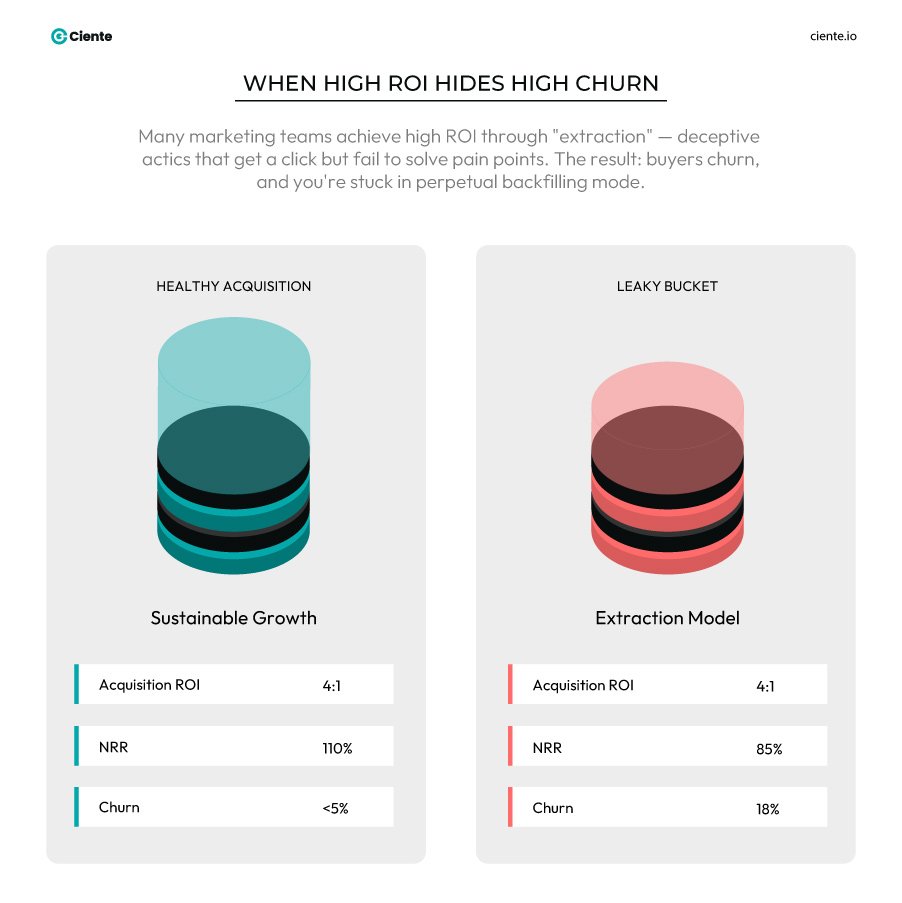
Many marketing teams achieve high ROI through “extraction”—using deceptive tactics to get a click. This content is unremarkable and repetitive. It’s “slop.”
- The Cost of Slop: When you attract a buyer through deceptive content that fails to solve their pain points, they will churn.
- The Backfilling Norm: High churn forces marketing into a perpetual “backfilling” mode. This is why reducing churn must become a core growth initiative rather than an afterthought in acquisition-heavy strategies focused only on ROI. You are constantly spending to replace lost customers rather than growing the base. Your ROI looks good on the acquisition side, but your net revenue retention (NRR) is a disaster.
The Digital Supply Chain and Vendor Integrity
Your ROI is only as good as the vendors in your supply chain. A bad vendor can mean the doom of an organization by providing lead lists of unverified data or low-quality work. The hidden risk of low-quality acquisition pipelines is well documented in discussions around the high cost of low-quality leads.
- The Blind Spots: Most marketing ROI doesn’t factor in the “reactionary” cost of bad vendors—the time sales wastes on dead leads or the PR fires lit by poorly managed campaigns.
- The Vendor Audit: To fix a leaky bucket, you must be willing to let go of vendors who provide “sludge.” Trust is built through customer understanding and showing proof, not just repeating an echo chamber of buzzwords.
Strategic ROI: Moving from Lead Gen to Market Domination
Marketing as a function is going back to its roots as a Strategic Management System. This evolution mirrors modern B2B SaaS growth marketing strategy frameworks that prioritize long-term market share over short-term lead spikes. It is not just about increasing ROI; it is about dominating the market share.
ABM and the “Hidden” Buyer Journey
In high-stakes industries like financial services or cybersecurity, the buyer’s journey is hidden. Dark social and buyer psychology elude traditional scoring systems.
- Uncovering Context: Account-Based Marketing (ABM) brings context to light. It allows you to understand why a CFO is pushing for a specific solution (perhaps a personal connection) and gives you the leverage to address the gaps in that solution.
- The Decision-Driving Factor: True ROI comes from driving decisions, not just being “consumed.” When marketing treats itself as a decision-driving partner, the ROI becomes a byproduct of market authority.
Solving the “Bleeding Neck” Problem
The ultimate “growth hack” for ROI is simple: solve a visceral pain point.
- Organic vs. Forced: Organic growth implies there is no force. Strong SaaS inbound marketing strategies create pull by addressing real buyer concerns instead of relying on paid amplification. There is thought, but not force. When you answer niche queries and solve specific objections from the sales team in real-time, you create a “pull” in the market. This is the foundation of a strong SaaS content marketing playbook built around intent-driven topics.
- The High-ROI Path: Niche topics solve specific pain points and lead to sales. Broader topics build authority. A balanced ROI strategy invests in both, rather than just chasing high-volume, low-intent keywords.
The Nightmare Variable: Why AI Security is the New ROI Factor
As we integrate AI into our marketing stacks—from Claude Code to ChatGPT APIs—we are creating new vulnerabilities. Understanding emerging AI SaaS trends 2026 is critical to balancing innovation with infrastructure security. In the age of “Adversarial AI,” perception is breaking.
The End of Perception and Its Cost
If your marketing scaling strategy involves unvetted AI systems on your servers, you are opening a door for bad actors to monitor proprietary data and code.
- Social Engineering with “Proof”: AI can create messages that seem genuine and social engineering that has “proof.” If your brand is associated with a security breach caused by poorly managed AI marketing tools, your ROI will evaporate overnight.
- The Anti-Fragile Network: A system that thrives under chaos and uncertainty is the only one that will survive. Your marketing ROI must factor in the cost of safeguarding your digital infrastructure. Security is no longer an IT problem; it is a brand perception problem.
How to Audit Your Real SaaS ROI: A 3-Step Framework
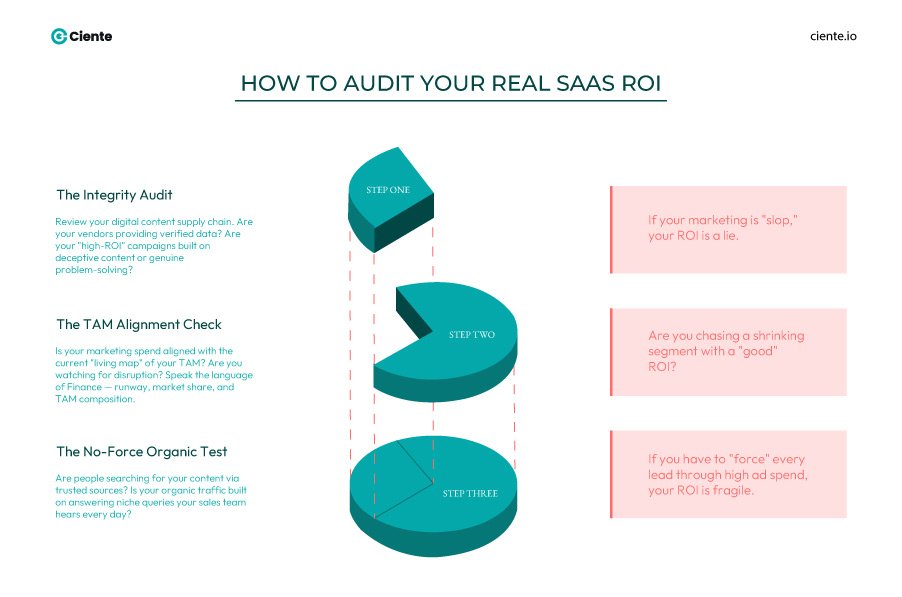
If you want to stop the leak and start building authority, you must move beyond the standard 4:1 ratio.
Step 1: The Integrity Audit
Review your digital content supply chain. Are your vendors providing verified data? Are your “high-ROI” campaigns built on deceptive content or genuine problem-solving? If your marketing is “slop,” your ROI is a lie.
Step 2: The TAM Alignment Check
Is your marketing spend aligned with the current “living map” of your TAM? Are you watching for disruption? Speak the language of Finance—runway, market share, and TAM composition—rather than just leads and clicks.
Step 3: The “No-Force” Organic Test
Are people searching for your content via trusted sources like LinkedIn or YouTube? Is your organic traffic built on answering niche queries that your sales team hears every day? If you have to “force” every lead through high ad spend, your ROI is fragile.
Trust is the Ultimate Competitive Advantage
A 4:1 ROI is a benchmark, not a strategy. In a world of noise, volume is no longer a virtue. Marketing must not devolve into noise by producing more volume; instead, it needs machines and strategies that help teams focus and prove impact.
True ROI comes from building a partner-based relationship with your buyers—one that quells their anxieties about the future rather than adding to them. When you solve real problems, maintain vendor integrity, and speak the language of finance, you move from being a “wrapper” company to a market authority.
The market is moving. The question is: are you building a business that leaks, or a moat that lasts?